

Table of Contents
You can go through all 27 PRISMA items carefully and still miss something a reviewer catches. That’s because a PRISMA gap doesn’t only show up when an item is skipped outright. It also shows up when a detail is implied rather than stated, described too vaguely, or tucked into a figure or table instead of the manuscript text. A requirement can look covered at first glance and still leave a reviewer with questions.
If you’re preparing a systematic review, catching these gaps while there’s still time to fix them is a lot easier than fixing them after a reviewer flags them in a revision request. This post walks through what PRISMA actually asks for, why a manuscript that “covers” every item can still have reporting gaps, and a 3-prompt workflow on Paperpal Agents that finds those gaps, checks your abstract separately, and helps you fix them without inventing details.
What is PRISMA?
PRISMA, also known as, Preferred Reporting Items for Systematic Reviews and Meta-Analyses, is a reporting guideline designed to help authors report systematic reviews clearly, completely, and transparently.
The current PRISMA 2020 guideline includes a 27-item checklist, an expanded checklist with more detailed reporting recommendations, a separate checklist for abstracts, and flow-diagram templates showing how studies move through the review process.
PRISMA doesn’t determine whether a systematic review is methodologically “good” or “bad”. It focuses on how clearly and completely the review is reported. In practice, that means telling readers what question the review addresses, how studies were found and selected, how data and risk of bias were assessed, how results were synthesised, and what the findings and limitations mean. The PRISMA 2020 statement recommends using the guideline throughout the writing process, not just at the final submission stage.
What does the PRISMA 2020 checklist cover?
The 27-item checklist is organised into seven broad sections. Several items contain sub-items, which is why the checklist involves considerably more than 27 individual reporting details in practice.
| Section | What you need to report |
|---|---|
| Title | Identify the paper as a systematic review and provide an informative title that reflects the review question. |
| Abstract | Report the abstract according to the separate PRISMA 2020 for Abstracts checklist. |
| Introduction | Explain the rationale for the review in the context of existing knowledge and state the review objectives or questions clearly. |
| Methods | Report eligibility criteria, information sources, search strategies, study-selection and data-collection processes, data items, risk-of-bias assessment, effect measures, and methods used to synthesise and assess the evidence. |
| Results | Show the study-selection process, characteristics of included studies, risk of bias, individual-study results, synthesis results, reporting-bias assessments, and certainty of evidence. |
| Discussion | Interpret the findings, discuss limitations of the evidence and review process, and explain implications for practice, policy, and future research. |
| Other information | Report registration and protocol details, amendments, funding or other support, competing interests, and the availability of data, code, and other materials. |
PRISMA isn’t just something to tick off before submission, it is meant to support transparent reporting across the whole manuscript. The Results section, for example, needs to show the study-selection process, which includes the numbers of records identified, screened, excluded, and included, ideally through a PRISMA flow diagram. The Discussion should address both the limitations of the evidence and the limitations of the review process itself.
That’s also why a manuscript can appear to “cover” PRISMA while still containing reporting gaps. The expanded checklist makes these underlying expectations far more explicit, making a final manuscript audit genuinely useful.
How to find and fix PRISMA gaps with Paperpal Agents?
Paperpal Agents are AI-powered research assistants that help researchers work through complex academic tasks using natural-language instructions and relevant research context. They bring research, writing, and document-based tasks into one conversational workspace, so researchers can move from an idea or question to a more structured, useful output without switching between multiple tools.
Agents can help build reference-backed outlines, analyze uploaded documents and research libraries, discover recent and relevant literature, refine and rewrite academic text, and work with supporting evidence to address reviewer comments.
Here’s a 3-prompt workflow on Paperpal Agents that finds those gaps, checks your abstract separately, and helps you fix them before submission, a structured way to review your manuscript against PRISMA and catch details that are easy to miss on a final read-through.
Step 1. Find every PRISMA gap in your systematic review
Open your review manuscript in Paperpal, click Agents in the sidebar, and copy the prompt below into the chatbox.
Agents will check your manuscript against every PRISMA item and create a table showing what has been clearly reported, what’s missing, and what’s merely implied.
PROMPT 1
Review the paper for PRISMA 2020 conformance. In a table, list all 27 checklist items and classify each as MET, PARTIAL/IMPLIED, or MISSING, flagging where conformance is assumed rather than stated.
Two principles apply:
(1) Performing a step does not by itself satisfy an item; the item must be explicitly reported.
(2) Content present only in a figure or table, but absent from the corresponding section text, does not constitute conformance. Table columns: Item (number + name) | Status (Met / Partial / Missing) | What’s missing or only implied
Step 2. Check your abstract separately
Your abstract has its own PRISMA checklist. Even if your manuscript reports everything PRISMA expects, that doesn’t mean your abstract does. Use this prompt in the same conversation to catch the reporting gaps in your abstract.
PROMPT 2
Audit my systematic review abstract document against the PRISMA-for-Abstracts checklist on the web (Beller et al., 2013 – PLoS Medicine). Judge the abstract on its own.
Return ONE table, one row per checklist item, with these columns: Item | Status (PRESENT / PARTIAL / MISSING) | What’s missing or under-stated.
Be strict: indicating something (“quality was assessed,” “several databases”) without naming it should be tagged PARTIAL, not PRESENT. Do NOT rewrite my abstract. After the table, give me only: the count of PRESENT / PARTIAL / MISSING, the single next item to fix first, and what specifically to add in order to address it.
3. Turn the gaps into usable wording, without fabricating details
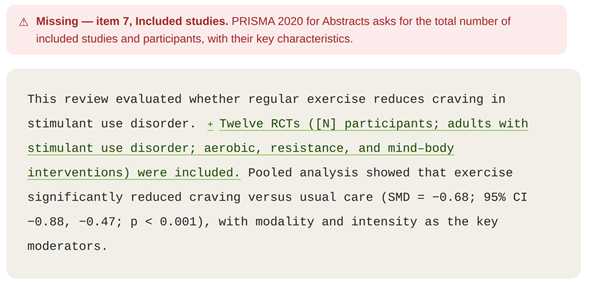
Once you know what’s PARTIAL or MISSING, choose the items you want to address. Continue in the same chat with Prompt 3, which asks Agents to draft the exact wording your manuscript needs and leave a placeholder for any detail that isn’t supplied by your content.
PROMPT 3
Show how to rewrite items [X, Y] flagged as PARTIAL or MISSING. For each, give me the exact wording to state it. The wording should be drafted only from the content I’ve provided. Add placeholders [ ] wherever you’d be guessing at a detail I haven’t supplied.
Check results on this screenshot
How this PRISMA gaps workflow helps you?
- A comprehensive audit against the PRISMA 2020 checklist. Review your manuscript across all relevant items and flag what’s missing, unclear, insufficiently detailed, or only implied.
- A dedicated PRISMA check for your abstract. Evaluate the abstract on its own terms, so required elements aren’t overlooked just because the full manuscript covers them.
- Clear, actionable wording to close the gaps — grounded only in what’s already in your manuscript, with no invented details.
Watch the research workflow in action
A final PRISMA check can help you catch reporting gaps while there’s still time to fix them. With a structured review of both your manuscript and your abstract, you can submit with more confidence that your reporting is complete and transparent. Try Paperpal Agents today!
 Paperpal for China
 Paperpal for Korea
 Paperpal for Japan


 Speak to us