


Table of Contents
Paraphrasing in academic writing is one of those research skills that most academics use every day but rarely receive formal training in. From literature reviews and research proposals to journal manuscripts and dissertations, researchers are constantly working with ideas that originated elsewhere. The challenge is not finding information—it is incorporating that information into a paper in a way that is accurate, readable, and properly attributed. A few changes in wording is not sufficient. Effective paraphrasing requires understanding what a source conveys and communicating that idea to fit the context of your work.1
Questions about paraphrasing often arise when writing about previous studies. How much can a sentence be changed before it becomes a genuine paraphrase? When does it need a citation? Can a well-cited text be considered plagiarism if it closely follows the original wording? These issues become particularly important in the literature review and/or discussion where findings from multiple sources need to be integrated. Understanding how paraphrasing, attribution, and citation work is therefore an critical part of scholarly writing.
This guide answers the most common questions about paraphrasing in academic writing, including citation requirements, common mistakes, and how a paraphrasing tool for academic writing can support the writing process without compromising academic integrity.
Key Takeaways
The key points below provide a quick overview of what this guide covers.
- Learn what paraphrasing in academic writing is, how it differs from summarizing, and why it plays a central role in literature reviews, research papers, theses, and dissertations.
- Understand when citations should be used, how APA and MLA citation rules differ, and how to avoid patchwriting and other forms of plagiarism.
- Explore the role of AI tools in paraphrasing, including their responsible use and ethical considerations.
How do you cite a paraphrase in academic writing?
While paraphrased text may look different from the original text, the underlying idea still belongs to the original source. For that reason, paraphrased material generally requires attribution.
Citations allow readers to trace information back to the research on which it is based. They also make it clear where existing scholarship ends and your own contribution begins. Consider the following example:
| Original Source | Paraphrased Version |
| Students who receive regular formative feedback tend to demonstrate higher levels of engagement and academic achievement. | Regular feedback has been linked to stronger student engagement and improved academic outcomes (Smith, 2024). |
Although the wording and sentence structure have changed, the underlying finding comes from Smith’s study. The paraphrase therefore requires attribution through an appropriate citation.
The exact citation format depends on the referencing style being used, such as APA, MLA, Chicago, or Harvard. Regardless of the style, the underlying rule remains consistent: if the idea originated from a source, the paraphrase should be accompanied by appropriate attribution.
How do you cite a paraphrase in APA format?
APA 7th edition emphasizes author-date referencing, making it easy for readers to identify both the source and its publication date.2
There are two common ways to cite a paraphrase in APA:
| Citation Type | Example |
| Parenthetical citation | Consistent sleep routines have been associated with improved academic performance among university students (Johnson, 2023). |
| Narrative citation | Johnson (2023) reported that students with consistent sleep routines tend to perform better academically. |
Are Page Numbers Required?
For paraphrased content, page numbers are not mandatory in APA. However, they may be included when referring to direct quotations or a specific finding, passage, or section of a source.
Example:
Students who receive frequent formative feedback are more likely to remain engaged in the learning process (Smith, 2024, p. 56).
How do you cite a paraphrase in MLA format?
MLA 9th edition cites paraphrased material using the author’s surname and page number.3 This style is widely used in humanities disciplines, where references often point readers to a particular passage or section of a text.
MLA Paraphrase Citation Formats
| Citation Type | Example |
| Parenthetical citation | Regular physical activity has been linked to lower levels of stress among university students (Smith 42). |
| Author incorporated into the sentence | Smith argues that regular physical activity contributes to lower stress levels among university students (42). |
| Source has no page numbers | Regular physical activity has been linked to lower levels of stress among university students (Smith). |
In all cases, the text has been rewritten, but the underlying information originates from Smith’s work and therefore requires attribution.
APA vs. MLA: A Quick Difference
| Feature | APA 7th Edition | MLA 9th Edition |
| Primary citation elements | Author + Year | Author + Page Number |
| Focus | Currency of research | Location within the source |
| Example | (Dane, 2024) | (Dane 42) |
| Common disciplines | Psychology, Education, Social Sciences, Health Sciences | Literature, Humanities, Languages |
Is paraphrasing considered plagiarism?
A proper paraphrase communicates an idea from a source using a different structure, different wording, and a different presentation while preserving the original meaning. It also includes a citation to acknowledge where the idea came from. When these elements are present, paraphrasing is a legitimate academic practice rather than plagiarism.
Not all paraphrases are equally effective. Some stay so close to the source that only a few words have been changed. This type of writing—often called patchwriting or mosaic plagiarism—retains much of the original wording, phrasing, or sentence structure despite appearing different at first glance.
| Effective Paraphrasing | Patchwriting / Mosaic Plagiarism |
| Reorganizes the information in a new way | Closely follows the original sentence structure |
| Uses original wording and phrasing | Relies heavily on the source’s language |
| Reflects the writer’s understanding of the source | Depends on word substitution rather than interpretation |
| Includes attribution | May still be problematic even if cited |
A useful test is to ask whether the paraphrase reflects your understanding of the source or merely disguises the original wording. If the source text remains clearly visible beneath the rewrite, the paraphrase likely needs further revision.
What is paraphrasing in academic writing — and when should you use it?
Paraphrasing in academic writing is a way of bringing information from a source into your writing without reproducing the author’s exact wording. It allows you to discuss previous research, explain concepts, and present evidence while maintaining a consistent style and line of argument throughout your paper. It gives writers the flexibility to integrate evidence more naturally and focus attention on the argument they are developing rather than the wording used by individual authors.
Researchers commonly paraphrase when they need to
- Discuss previous study findings without reproducing the original wording.
- Compare results across papers and highlight areas of agreement or disagreement.
- Explain theories, frameworks, or models in a way that fits the context of their own discussion.
- Write literature reviews, where information from many sources needs to be woven into a coherent narrative.
- Support claims with published evidence while maintaining a consistent writing style throughout the manuscript.
Paraphrasing in academic writing is less about rewriting sentences and more about incorporating previous work into the discussion, drawing on existing evidence while keeping the focus on their own analysis, interpretation, and research questions.
Does paraphrasing require a citation? Do you need to cite every paraphrase in a research paper?
If a paraphrase is based on someone else’s idea, finding, argument, interpretation, theory, or data, it should be cited. Changing the wording of a source does not change the ownership of the underlying intellectual contribution.
This principle is often referred to as intellectual attribution—acknowledging where ideas, findings, and interpretations originate. Citations help readers distinguish between your contribution and insights drawn from previous research. Without that attribution, a paraphrased idea can easily be mistaken for your own.
A citation is generally required when you paraphrase the following:
| Type of Content | Citation Needed? |
| Research findings from a journal article | Yes |
| An author’s argument or interpretation | Yes |
| A theory, framework, or model | Yes |
| Statistical results or data | Yes |
| Information from books, reports, or dissertations | Yes |
| Common knowledge | Usually No |
For example, if you rewrite a study’s conclusion in your own words, the wording may be original, but the conclusion itself still belongs to the study’s authors. The paraphrase therefore requires citation.
Do You Need to Cite Every Sentence?
If several consecutive sentences discuss the same source, citation need not be given after every sentences. The key is ensuring that readers can clearly identify which information comes from which source. Whenever the source changes—or there is potential for ambiguity—a new citation should be provided.
What About Self-Plagiarism?
Reusing large sections from a previously published paper without acknowledgment can raise self-plagiarism concerns. Although the work is yours, academic publishing generally expects authors to be transparent about material that has appeared elsewhere.
A useful rule is to focus on the source of the idea rather than the wording used to express it. If the information originated from a specific source—whether someone else’s publication or your own earlier work—it should generally be acknowledged through appropriate citation.
What is the difference between paraphrasing and summarising?
Researchers use both paraphrasing and summarizing when working with sources, but the two serve different purposes. Paraphrasing in academic writing is typically used to discuss a specific study, argument, or finding in detail, whereas summarizing condenses larger sections of text or brings together key points from multiple sources. Although both involve rewriting information in your own words, they differ in the amount of detail retained and the role they play in a research paper, as shown below.
| Paraphrasing | Summarizing | |
| Purpose | Restate a specific idea or passage | Condense the main points of a larger text |
| Level of Detail | Retains most of the original information | Includes only essential information |
| Length | Often similar in length to the original passage | Significantly shorter than the original text |
| Focus | Individual findings, arguments, or concepts | Overall message or major conclusions |
| Typical Use | Discussing specific studies or evidence | Providing an overview of a source or body of literature |
| Citation Required? | Yes | Yes |
Does paraphrasing remove AI detection flags?
The idea that paraphrasing can reliably “humanize” AI-generated text has become increasingly common with the rise of AI writing and rewriting tools. The assumption is straightforward: if the wording changes, AI detectors will no longer recognize the text as machine-generated. However, current detection systems do not operate solely at the level of individual words or phrases, making this approach far less effective than many users expect.
Most AI detection systems assess broader writing patterns rather than isolated phrases. They may analyze features such as sentence structure, stylistic consistency, vocabulary distribution, and language predictability. Hence, making surface-level changes to wording is unlikely to substantially affect what the detector is evaluating.
| Why Paraphrasing Doesn’t Guarantee Lower AI Detection Scores | What Happens in Practice |
| The underlying structure often remains unchanged | Many paraphrasing tools for academic writing rewrite sentences while preserving the original sequence of ideas and overall organization. |
| Language patterns can persist across rewrites | Even when wording changes, broader stylistic features may remain similar. |
| Automated rewrites can introduce new signals | Some paraphrasing tools for academic writing produce repetitive phrasing, unnatural word choices, or formulaic sentence structures. |
| Detectors assess entire passages, not isolated sentences | Small edits may have limited impact on the overall linguistic profile of a document. |
The reliability of AI detection itself is another challenge. Detection tools frequently produce inconsistent results because they rely on probabilistic models rather than direct evidence of how a text was created. The same paragraph may receive different scores across platforms, and even fully human-written content can sometimes be flagged as AI-generated.
For researchers, the focus should be on authorship and transparency rather than AI detection. A paraphrase may alter the wording of a passage, but it does not change the underlying ideas or how the content was produced. That is why paraphrasing is not a dependable way to bypass AI detection systems.
Is paraphrasing allowed in research papers?
Academic writing depends heavily on engagement with existing literature, especially in literature review and discussion sections. However, the balance between paraphrasing and direct quotation depends largely on the field and purpose. In fields such as STEM, where emphasis is on communicating findings and evidence, paraphrasing is common. In contrast, in literature, philosophy, or history, where the precise wording of a source forms the subject of analysis, quotations appear more frequently.
| Discipline | Typical Use of Paraphrasing |
| Natural and Health Sciences | Extensively used to discuss findings, methods, and prior research |
| Social Sciences | Common in literature reviews, theoretical discussions, and interpretation of results |
| Engineering and Technology | Frequently used when describing previous studies and technical developments |
| Humanities and Literary Studies | Used alongside direct quotations, particularly when analyzing texts |
| Law | Often combined with direct citation of statutes, regulations, and legal opinions |
Can I use AI to paraphrase? And does this kind of paraphrasing count as ethical AI use?
AI tools can be used to support paraphrasing in academic writing, and many researchers now use them as part of their writing process. If you have already read and understood a source, AI can be useful during revision. It can help improve clarity, reduce repetition, or suggest alternative wording. In this role, the tool is helping with expression rather than interpretation.
The choice of tool is also important. As opposed to generic tools, academic writing tools for paraphrasing are better suited to research manuscripts, supporting tasks such as citation management, language editing, and manuscript preparation.
However, using AI on papers you have not read carefully can lead to paraphrases that overlook important context or misrepresent the authors’ findings.
Uses That Require Caution
| Practice | Risk |
| Paraphrasing sources you have not read | Important context or nuances may be lost |
| Accepting AI output without review | Technical inaccuracies can be introduced |
| Removing citations because the wording changed | Can create plagiarism issues |
| Treating AI-generated text as original scholarship | Weakens transparency and authorship |
Ultimately, ethical AI use comes down to authorship. If the AI is helping you communicate ideas that you understand and have critically evaluated, its use is generally consistent with responsible academic practice. If it is being used to replace that intellectual effort, the situation becomes much more difficult to justify.
How to Paraphrase Correctly in Academic Writing: A Paperpal Workflow
AI can be used to support paraphrasing in academic writing, and in many research environments it is increasingly being used that way. The more important question is whether the AI is helping you communicate your understanding of a source or replacing the process of understanding it. A useful way to think about it is as follows:
| Ethical Use | Problematic Use |
| Improving wording after reading the source | Paraphrasing papers you have not read |
| Refining clarity and sentence flow | Using AI output without fact-checking |
| Simplifying overly complex language | Removing citations after rewriting |
| Editing your own draft | Presenting AI-generated analysis as your own |
One challenge with AI paraphrasing is that academic writing depends heavily on context. A sentence in a research paper often reflects methodological choices, disciplinary terminology, statistical interpretation, or theoretical assumptions. Generic paraphrasing tools for academic writing may rewrite the language while weakening that context.
This is one reason researchers increasingly prefer academic-focused tools such as Paperpal. These platforms place paraphrasing within a broader workflow that includes language editing, citation support, manuscript review, plagiarism screening, and journal-readiness checks.
Paperpal, for example, combines paraphrasing with other writing and editing features and can assist with manuscript improvement directly within writing environments such as Word, Google Docs, and Overleaf.
When revising a draft, researchers commonly use these features to
- Improve sentence clarity without changing technical meaning
- Remove redundancy across sections
- Adjust language to match academic writing conventions
- Condense text to meet journal word-count requirements
- Rewrite lengthy or awkward sentences for better readability
In practice, paraphrasing in academic writing is rarely treated as an isolated task. It is usually part of a larger revision process aimed at making a manuscript clearer, more concise, and easier for reviewers and readers to follow.
Using Paperpal to Paraphrase Text (Short Steps)
Step 1: Paste Your Text
Copy and paste the paragraph into the Paperpal editor.
Step 2: Select the Text
Highlight the sentence or paragraph you want to improve.
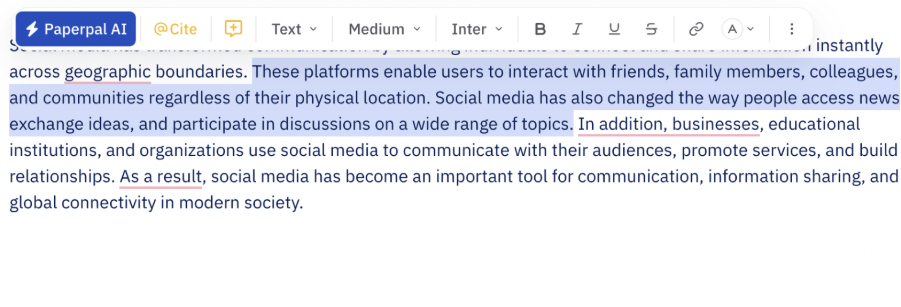
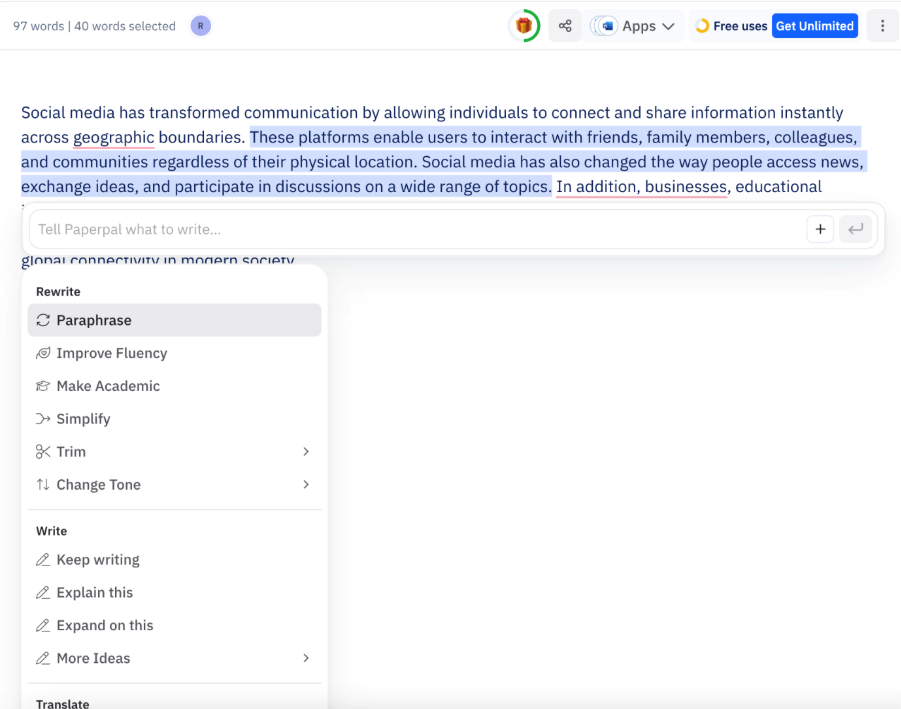
Step 3: Click Paperpal AI and then click Paraphrase
Choose the Paraphrase option from Paperpal AI.
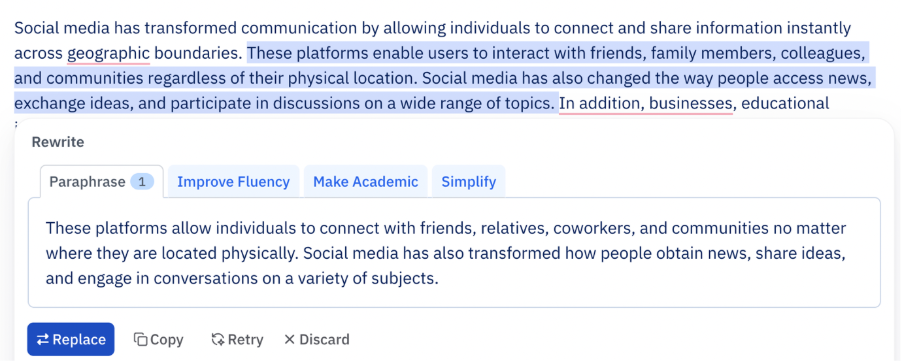
Step 3: Edit and Save
Make any final changes, ensure the meaning is accurate, and save the revised text.
Paraphrasing in academic writing is something most researchers do repeatedly throughout the writing process, often without paying much attention to it until a citation question or similarity concern arises. A literature review, for example, may require dozens of studies to be discussed in a relatively small space. Simply quoting those studies would make the text difficult to read, so researchers rely on paraphrasing to explain findings, compare results, and connect ideas across sources.
The increased availability of AI writing tools for paraphrasing has made paraphrasing faster, but it has not made it simpler. A rewritten sentence can still omit important context, alter a study’s meaning, or stay too close to the original source. For that reason, reading the source carefully remains more important than any paraphrasing technique or software feature.
This is where tools such as Paperpal fit into the writing process. Rather than functioning solely as a paraphrasing tool, it supports multiple stages of manuscript development, including academic language editing, citation assistance, literature search, plagiarism checks, translation, and pre-submission review.
However, for many researchers, paraphrasing is only one step in a much larger workflow that begins with reading and analysis and ends with manuscript submission. However, when researchers have a clear understanding of the source, they are able to accurately integrate it into their discussion. That is what makes paraphrasing valuable in academic writing—the ability to engage with existing research and use it responsibly.
References
- Na, C. D., & Nhat Chi Mai, N. X. (2017). Paraphrasing in academic writing: A case study of Vietnamese learners of English. Language Education in Asia, 8(1), 9-24.
- American Psychological Association. (n.d.). Style and grammar guidelines. APA Style. https://apastyle.apa.org/style-grammar-guidelines
- Modern Language Association. (n.d.). MLA format. MLA Style Center. https://style.mla.org/mla-format
 Paperpal for China
 Paperpal for Korea
 Paperpal for Japan


 Speak to us