


Table of Contents
A research paper appendix is an often underappreciated element of the submission package. The appendix in a research paper typically contains supplementary material relevant to your study. Such an appendix helps maintain the flow and readability of the main text while providing readers with additional details that support the research findings. Appendices in research papers are especially useful for including raw data, detailed calculations, interview transcripts, and other supporting documents that would otherwise disrupt the narrative if placed in the body of the paper.
Many researchers struggle with determining what to include in an appendix and how to format it correctly, as well as where to position appendices in research papers. Writing an appendix for a research paper requires careful consideration of what materials enhance your research without overwhelming readers. This comprehensive guide will walk you through everything you need to know about creating effective appendix examples in research paper contexts, from understanding “what is an appendix in a research paper?” to learning how to refer to an appendices in various styles. Here, you will learn in detail about the purpose, format, and content of a research paper appendix, which is vital for producing a polished and comprehensive manuscript.
What is an Appendix in Research Papers?
Definition: An appendix in a research paper is a separate section at the end of the article that contains supplementary information not essential to the main argument but relevant to the research. This may include lengthy datasets, detailed methodologies, calculations, technical specifications, extensive tables, questionnaires, interview transcripts, or any material that is excessively long or detailed for the main body.
Unlike the main body of your paper, which presents synthesized findings and arguments, appendices in research provide the granular details that substantiate your claims and allow for the replication of your work. The appendix section of a research paper may contain one or multiple appendices, each clearly labeled and referenced within the main text.
Importance of an Appendix in Research Papers
The appendix in a scientific paper aims to provide transparency and reproducibility, ensuring that readers have access to all the background information needed to understand or replicate your work. Importantly, appendices allow researchers to present additional evidence and supporting details without cluttering the main text or distracting the reader. This helps keep the core narrative concise and the flow focused while still offering comprehensive support for the claims. Appendices also serve as a repository for materials that may be of interest to specialist readers, reviewers, or future researchers. What to include in an appendix often determines whether reviewers can adequately assess the validity of your methodology and whether other researchers can replicate your study. The appendix in scientific paper submissions provides a clear record of how data were collected, coded, and analyzed, which strengthens the trustworthiness of the findings.
This self-contained section of a research paper can be used when there are constraints placed on the length of your paper and to further demonstrate your understanding of the research problem by giving additional details about a new or innovative method, technical details, or design protocols.
Key Points to Consider While Adding an Appendix
When adding an appendix to your research paper, there are several key points to keep in mind. First, only include information that is relevant but not critical to the main argument; your paper should be complete without the appendix. Second, ensure that the material is well-organized and clearly labeled, making it easy for readers to navigate. Third, always refer to the appendix in the main text where relevant, so that readers know when to consult it. Finally, check the specific guidelines of your target journal or institution, as formatting and labeling requirements may vary.
What to Include in a Research Paper Appendix
In a nutshell, here are the elements that are usually included in appendices in research papers:
- Supplementary results and detailed data that are not central to your findings.
- Raw datasets or extensive tables that support your analysis.
- Questionnaires, surveys, or interview transcripts used in your study.
- Detailed methodologies, protocols, or technical specifications.
- Mathematical derivations, formulas, or complex calculations.
- Ethical documentation, consent forms, or IRB approvals.
- Visual aids such as additional charts, graphs, or diagrams.
In addition, there might be certain other aspects related to research paper appendices that should be considered.
- Provide a list of abbreviations if a lot of them appear in the article.
- When using many specialized or technical terms, consider providing a glossary of such terms.
- If you have a large volume of tables, figures, charts, and illustrations, you could insert a list of figures and tables as well.
The addition of maps, images, diagrams, etc., in appendices makes it informative; however, the study must be clear and understandable without them. Long and complex appendices should be divided into separate appendices, allowing easier navigation.
How to Format an Appendix in Research Papers (Step by Step)
1. After the main text, begin each appendix on a separate page with a clear heading (e.g., “Appendix A,” “Appendix B”). If there is only one appendix, simply label it “Appendix.”
2. Provide a descriptive title below the heading (e.g., “Appendix A: Survey questionnaire”).
3. Center-align and bold the heading and title at the top of the page.
4. If you have multiple appendices, label them sequentially (Appendix A, Appendix B, etc.) and ensure each is on its own page.
5. Sections within appendices should be numbered (i.e., A.1, A.2), e.g., Figure A.1, table A.1, equation A1.
6. Format all content in the appendix consistently, using the same font and spacing as the main paper.
7. Refer to each appendix in the main text where appropriate, e.g., “(See Appendix A for more details)” or “(See Appendices A and B for the complete code).”
It is a good practice to consult the writing style guide (e.g., APA, Chicago) that is expected by the target publication.
You can see the format of an appendix in a research paper in Figure 1 and some samples of appendices in research papers in Figure 2.
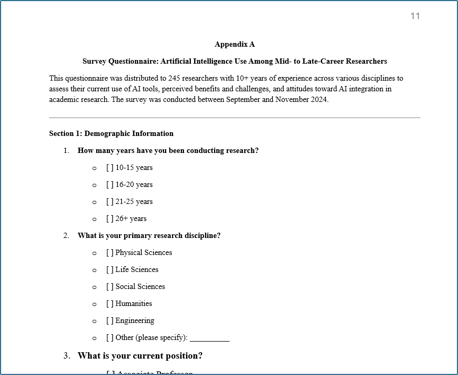
Figure 1 Format of an appendix in a research paper.
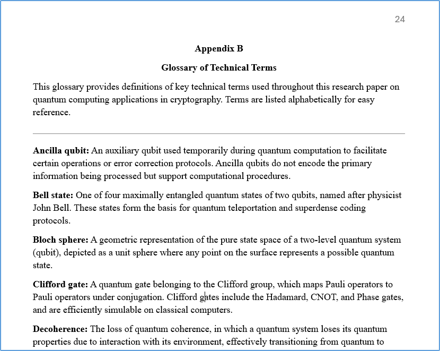
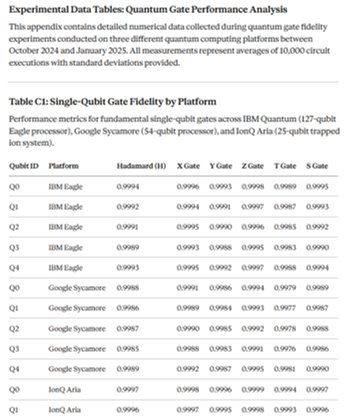
Figure 2. Research paper appendix examples.
How to Refer to an Appendix
Besides knowing about writing an appendix for a research paper, you should also know how to refer to one. When referring to an appendix in your research paper, use clear and consistent language. Always mention the appendix in the main text where the supplementary material is relevant, so that readers know where to look for additional information.
Here are some examples of referring to a research paper appendix:
- “See Appendix A for the full survey questionnaire.”
- “Refer to Appendix 1 for interview transcripts.”
- “Appendix B contains the raw data tables.”
Tip: Do not include an appendix that is not referred to in the text. Where relevant to the content, the specific appendix should be called out in the research article.
Where to Put Your Research Paper Appendix
The appendix section of a research paper should always be placed at the end of your document (Figure 3), after the main text. Appendices may precede or follow your list of references; refer to the style being followed. Each appendix should start on a new page, with clear headings and titles. This placement ensures that your appendix is easy to find and does not interfere with the flow of your main argument.
If you have a whole lot of data or information that is difficult to present textually, you could consider uploading the appendices online. First check that your journal has a provision for online appendices. Second, be sure to provide the correct URL and access procedures in the research paper, as well as clear information on how to contact the author to obtain access.
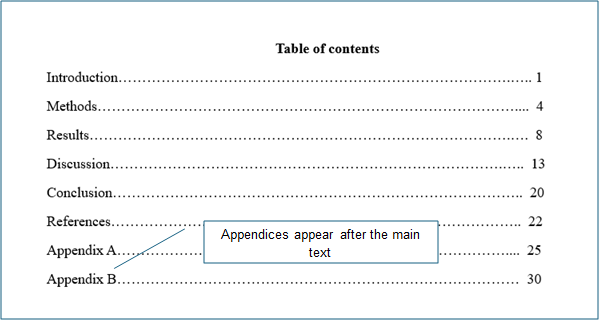
Figure 3. The appendix section of a research paper is placed at the end of the document.
Summing it up
Appendices are valuable tools for research papers, providing a dedicated space for supplementary material that supports your main argument without disrupting its flow. Remember to (i) only include relevant but non-essential information, (ii) ensure each appendix is clearly labeled and referenced in the main text, and (iii) maintain consistent formatting throughout. Not every paper requires an appendix. Include a research paper appendix only when you have detailed materials like raw data, questionnaires, or technical specifications that would benefit specialist readers or enable replication of your study. Now that you know what to include in an appendix in a scientific paper and how to format an appendix, you will be able to keep your main narrative focused and readable, while ensuring transparency and rigor.
Frequently Asked Questions
Appendices are supplementary sections at the end of a research paper that contain additional material like raw data, questionnaires, detailed calculations, or technical information that would otherwise disrupt the main text’s flow. Appendices in research provide the details that substantiate your claims and allow for the replication of your work. A paper may contain one or multiple appendices, each clearly labeled and referenced within the main text.
No. Only include an appendix if you have supplementary material that supports your research but is too detailed or lengthy for the main body of the paper.
A list of appendices is a table of contents for your appendices, listing each appendix by letter or number with its title and page number. A list of appendices is useful when you have multiple appendices.
The appendix is placed at the end of the paper, before or after the reference list (depending on the style followed by the target journal). If there are multiple appendices, they should be ordered as they are mentioned in the text.
Appendices in research papers contain materials created by the author specifically for the research, e.g., original data tables, interview transcripts, statistical outputs. They are directly generated from or for the specific research. Meanwhile, an annex contains external materials or documents created by others. An annex may include published regulations, existing legal documents, third-party reports, official letters—material that exists independently of your research but supports it. Note that annexes are more common in policy papers, technical reports, and legal documents than in scientific papers.
You can use the following checklist to ensure that your appendices are properly formatted, complete, and effectively integrated into your research paper:
– Does the target journal or institution allow appendices?
– What are specific formatting guidelines for appendices in the style guide?
– Is the supplementary material necessary but non-essential to the main argument?
– Does each appendix start on a new page.
– Each appendix is numbered and has a number and clear title.
– The appendices are easy to follow and clearly formatted.
– Each appendix has been referred to at least once in the main text.
Yes. If your appendix contains information from external sources, you must cite them properly using the same citation style as your main paper. Include any appendix-specific references in your main reference list.
Yes, if your paper includes a table of contents, list all appendices with their titles and page numbers. This helps readers quickly locate the materials they need to reference.
No. Appendices should only be referenced in the main body of your paper, never in the abstract. The abstract must be self-contained, and readers should understand your core findings without consulting any appendices. Moreover, the appendices appear at the end of the document.
Paperpal is a comprehensive AI writing toolkit that helps students and researchers achieve 2x the writing in half the time. It leverages 23+ years of STM experience and insights from millions of research articles to provide in-depth academic writing, language editing, and submission readiness support to help you write better, faster.
Get accurate academic translations, rewriting support, grammar checks, vocabulary suggestions, and generative AI assistance that delivers human precision at machine speed. Try for free or upgrade to Paperpal Prime starting at US$25 a month to access premium features, including consistency, plagiarism, and 30+ submission readiness checks to help you succeed.
Experience the future of academic writing – Sign up to Paperpal and start writing for free!
 Paperpal for China
 Paperpal for Korea
 Paperpal for Japan


 Speak to us