


For the longest time, we at Paperpal didn’t want to build an AI detector. Reducing complex human thought, collaboration, and creativity to a binary label of human or AI felt deeply flawed. Writing, especially in academia, has always been a deeply human process, a negotiation between knowledge, experience, and, now increasingly, technology.
But the way writing happens has changed. Academics today are using AI as a learning companion to brainstorm ideas, define structure, or polish phrasing. Others rely on it more heavily to think, organize, and express ideas more clearly. That can be empowering, but it also blurs the lines. Writing styles start to sound alike, biases carry through, and text is sometimes submitted without enough real human reflection. This shift forced us to rethink our position.
Why Paperpal Built Its Academic AI Text Detector
We realized that academia doesn’t need another policing tool, but a clearer lens; something that helps people understand how AI may have shaped a piece of writing, without making moral judgments about it. An AI content detector that doesn’t shame, but clarifies. One that doesn’t claim absolute truth, but offers perspective.
This is because the line between “AI-written” and “human-written” is fading fast. Modern language models are trained on text that already carries traces of AI. Everyday editing tools now quietly embed AI into the writing process. What we call “human writing” today is already, in some ways, hybrid.
So our goal with Paperpal’s AI Detector isn’t to decide who wrote what. It’s to highlight where human presence, intervention, and insight appear in academic writing. Over time, we believe this can evolve beyond AI text detection into something far more meaningful: a deeper recognition of human contribution.
This is just the beginning; a first step in helping students, educators, and researchers navigate a new era of authorship with awareness and integrity. This philosophy shapes not just why we built Paperpal’s AI detector, but how we built it.
How Paperpal Is Different from Other AI Detectors
Most AI detection tools today have emerged in response to widespread uncertainty about the use of generative AI in writing. As a result, many focus primarily on flagging text and presenting a detection score, often without sufficient explanation of how that assessment was reached. For authors, this can create confusion, particularly when original writing is misclassified or when probabilistic outputs are interpreted as definitive proof.
Paperpal attempts to take a different approach. We designed our AI detector as a support tool, one that reflects the reality of modern academic writing, which is increasingly hybrid and iterative. Instead of relying on a single aggregate score, Paperpal evaluates text from the sentence level upward, building a contextual, document-level view. Writing is assessed on a three-band scale — human, human–AI blend, or AI — providing greater transparency about how different parts of a text are interpreted.
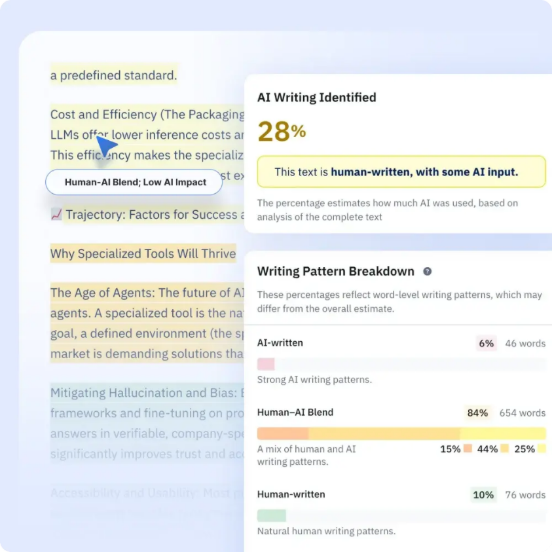
Because Paperpal’s detection models are specifically tuned for academic writing, its assessments align more closely with scholarly norms and publisher expectations than those of general-purpose detectors. Importantly, AI detection is not treated as an endpoint. Paperpal enables authors with tools to immediately review, revise, and improve flagged passages, edit language, grammar, or tone to ensure clarity, and check for plagiarism or journal submission, all within a single, connected writing environment.
AI Detection, Grounded in Responsibility and Trust
At its core, Paperpal’s approach is ethics-first. We don’t decide authorship. We provide context and signals so humans can make informed judgments. We do not retain user data, report to institutions, claim to prove originality, or help writers “optimize” text to bypass AI detection.
In doing so, we aim to reframe AI detection not as a compliance hurdle, but as a tool for awareness: one that keeps human contribution visible in an era where writing is no longer purely one thing or the other.
Whether you are a student trying to meet a university’s AI score requirement, a sincere writer trying to understand your own process, or a professor overwhelmed by essay reviews, our hope is that Paperpal’s AI detection tool provides clear context, not judgment.
We built this because we believe human creativity still matters, not as a boundary to defend, but as something worth understanding, nurturing, and making visible again.
If you’re curious about why clearly original writing enhanced using AI can still be flagged by AI checkers, we cover that in a separate post and tell you why it isn’t necessarily a problem.
Paperpal is a comprehensive AI writing toolkit that helps students and researchers achieve 2x the writing in half the time. It leverages 23+ years of STM experience and insights from millions of research articles to provide in-depth academic writing, language editing, and submission readiness support to help you write better, faster.
Get accurate academic translations, rewriting support, grammar checks, vocabulary suggestions, and generative AI assistance that delivers human precision at machine speed. Try for free or upgrade to Paperpal Prime starting at US$25 a month to access premium features, including consistency, plagiarism, and 30+ submission readiness checks to help you succeed.
Experience the future of academic writing – Sign up to Paperpal and start writing for free!
 Paperpal for China
 Paperpal for Korea
 Paperpal for Japan


 Speak to us