

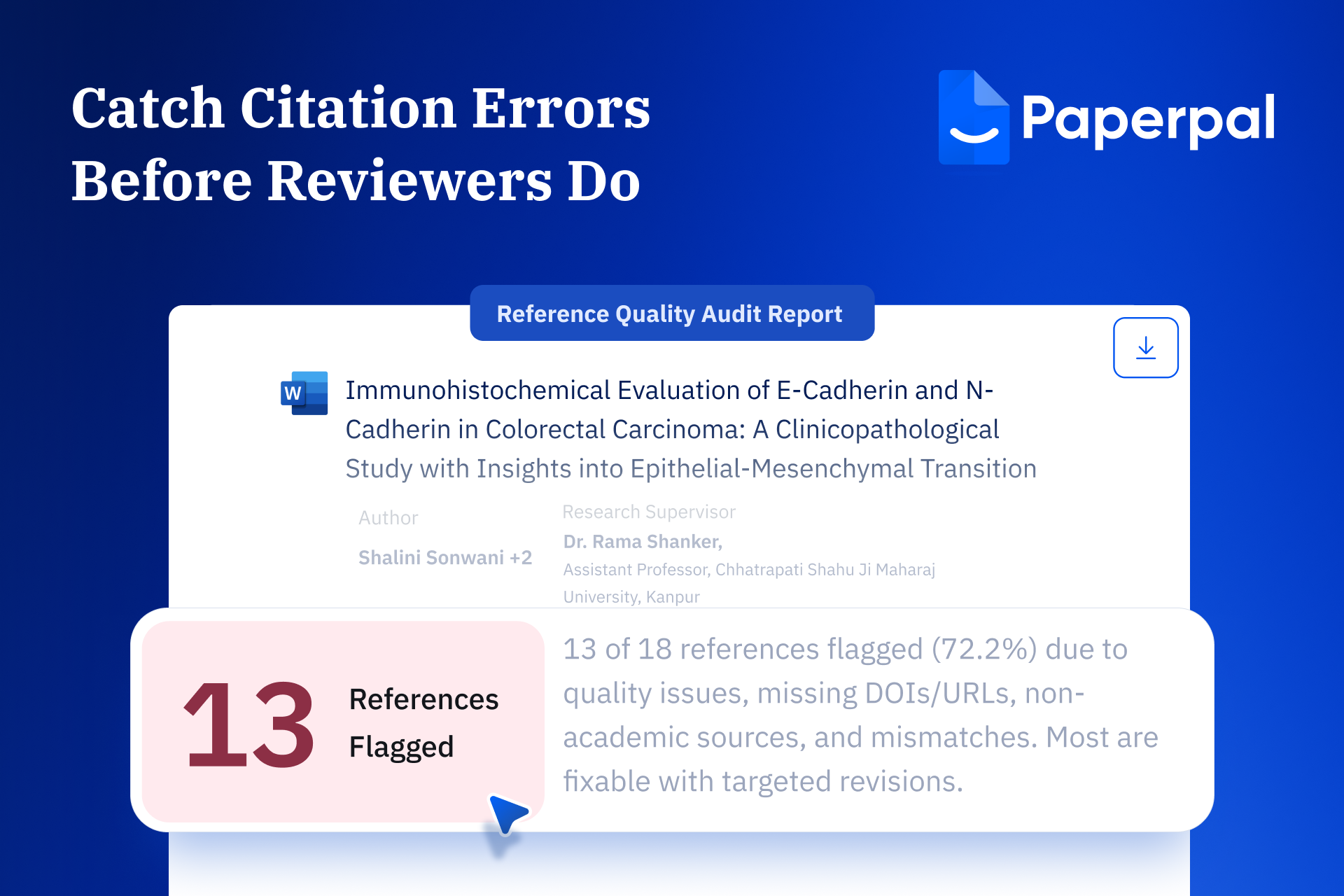
If you’ve submitted a manuscript in the last year or two, you’ve probably noticed reviewers asking sharper questions about your reference list than they used to. That’s not a coincidence. With AI writing tools becoming part of nearly every researcher’s workflow, the reference list, once the most mechanical part of a paper, has quietly become one of the riskiest.
This is why Paperpal has introduced its Reference Checker, featuring in-depth validation checks covering everything from retracted studies and AI-hallucinated citations to broken links and citation relevance. It’s designed to catch the kind of issues that increasingly show up as reasons for desk rejections and post-publication corrections, before they cost you.
The Citation Problems Researchers Most Often Miss
Most researchers were trained to check references for formatting. Those checks still matter, but the errors that actually derail submissions today are ones a human eye can’t easily spot.
- Hallucinated references: AI tools generate citations that look real with plausible journal names, realistic titles, and properly formatted DOIs for papers that don’t exist. A study of 100 hallucinated citations found in NeurIPS 2025 accepted papers, each reviewed by 3-5 researchers, found two-thirds were total fabrications. If fake citations can pass expert peer review at a top AI conference, they can easily slip through a final author read-through.
- Retracted papers: Citing a retracted study isn’t just an oversight; in clinical or policy-relevant fields, it can actively undermine your argument. Retraction notices are scattered across publisher websites, Retraction Watch, PubMed, and Crossref; there’s no one single place to check this before you submit.
- Broken DOIs and URLs: Dead links leave references inaccessible. When a DOI doesn’t resolve, an editor doing a spot-check asks one question: did the author actually read this source?
- Irrelevant or weak references. A citation that’s technically real but doesn’t support the specific claim it’s attached to is its own kind of problem. A sharp reviewer will notice the mismatch faster than you’d expect.
A typical research article cites 40–80 sources; a thesis or dissertation can run into the hundreds. Verifying each one manually, checking it exists, isn’t retracted, resolves correctly, and actually supports your argument. is realistically a multi-hour task most researchers can’t afford before a submission deadline.
Reference managers like Zotero or EndNote handle formatting and deduplication well, but they don’t tell you whether a paper has been retracted since you added it, whether a DOI still resolves, or whether an AI tool slipped a fabricated source into your draft. That’s the gap Paperpal’s Reference Checker closes.
How Paperpal Reference Checker Works
Paperpal’s Reference Checker parses your manuscript the way an editor would. It identifies the title, abstract, and main sections, matches every in-text citation to its corresponding reference list entry, and pulls structured details (authors, journal, year, volume, DOI) for each source.
It then cross-checks everything against its verified database of 250M+ articles and produces a detailed action report showing exactly which references passed, which need review, and which require action. The result is something no manual process or reference manager delivers: a systematic, evidence-based confidence check on your entire reference list, completed in minutes.
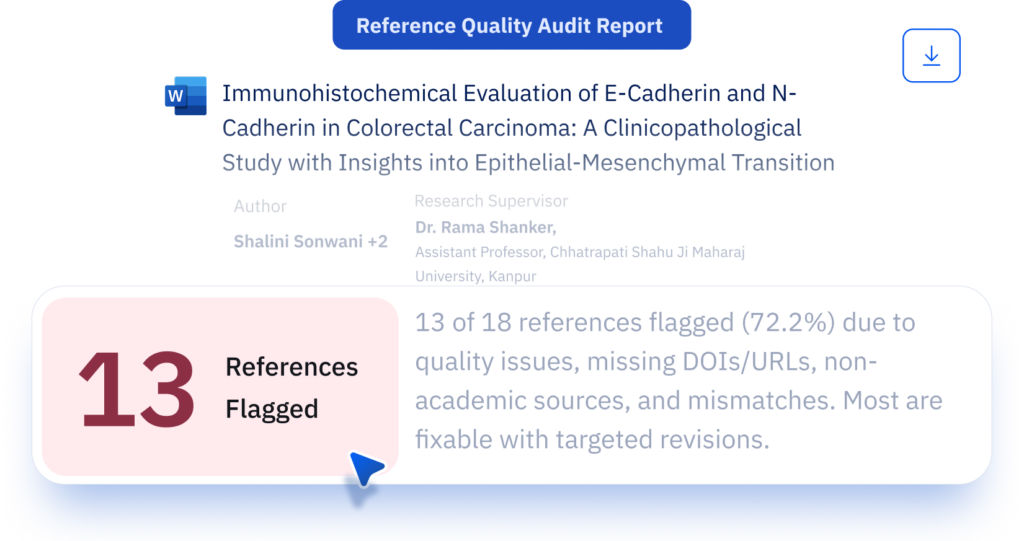
Available with the Prime plan, Paperpal Reference Checker lets you check 10,000 words per month, with pay-per-use options for larger documents. Upload your manuscript to review your citations and get a report within minutes. See how Paperpal’s Reference Checker works on a real manuscript.
Paperpal Runs a Comprehensive Suite of Citation Checks
Citation errors are easy to miss, especially when sources are pulled from different reference managers or co-author drafts. Paperpal’s Reference Checker catches hallucinated references and citation errors before you submit with its powerful suite of automated checks.
- Retracted research scan: Flags references that have been formally retracted or withdrawn, so you’re not unknowingly building on invalidated findings.
- Broken links detection: Catches dead URLs and invalid DOIs that suggest a reference may not point to a real, accessible source.
- Journal quality check: Detects citations from unindexed or low-quality journals that could raise questions about the credibility of your sources.
- Citation relevance check: Verifies that each reference actually supports the specific claim it’s attached to, not just that it sounds topically related.
- Missing reference match: Identifies in-text citations with no corresponding reference list entry, and list entries never cited in the text.
- Self-citation monitor: Spots an unusually high proportion of citations to your own prior work, which can raise objectivity concerns with editors.
- Abstract citation alert: Checks whether your abstract includes citations, which most journals discourage or prohibit outright.
- Citation density review: Looks at your overall citation-to-word ratio to flag sections that may be under-supported or over-cited.
- Older references check: Surfaces sources older than 10–15 years; an over-reliance on dated literature can signal an incomplete picture of the current field.
How Does Your Reference Checking Method Stack Up?
Reference managers offer limited support with checking citations; this is why a dedicated reference check is the smartest move you can make for your research. If you’re still unsure if you should check references online before submission and how, here’s a quick snapshot of what different approaches are equipped to catch to help you make the right choice.
| Checks | Manual checking | Reference managers (Zotero/EndNote) | Paperpal Reference Checker |
| Formatting & style errors | ✓ | ✓ | ✓ |
| Retraction detection | Partial (manual scan) | Partial (DOI/PMID only; not manuscript-level) | ✓ |
| AI hallucination detection | ✗ | ✗ | ✓ |
| DOI/URL validation | Partial (manual check) | ✗ | ✓ |
| Citation relevance check | ✓ | ✗ | ✓ |
| Missing citation match | Partial | Partial | ✓ |
| Journal quality check | ✗ | ✗ | ✓ |
| Scales to 100+ references | ✗ | ✓ | ✓ |
| Generates action report | ✗ | ✗ | ✓ |
Ensure your citations are accurate, complete, and publication-ready.
Why Reference Quality Matters Now More Than Ever
The numbers make the case plainly. A Lancet study showed fabricated citations appeared in roughly 1 in 458 papers in 2025, up from 1 in 2,828 in 2023 — a sixfold increase in two years — and the rate reached 1 in 277 papers in the first seven weeks of 2026. A separate audit of 2.5 million scientific papers identified close to 147,000 AI-generated fake citations in 2025 alone.
On the retraction side, a recent study pointed to a record 14,000+ retractions in 2023, with more than 9,000 added in 2024. Even large, well-resourced publishers aren’t immune; Retraction Watch revealed Springer Nature alone reported 2,923 retracted articles out of 482,000+ published in 2024.
None of this is meant to alarm you. It’s meant to explain why the “check my references” step has quietly become as important as “check my grammar” — and why doing it manually is much harder than it used to be.
A single fabricated or retracted reference can shift a manuscript from “minor revisions” to “major concerns about research integrity” even when the actual research and writing are sound. That’s why checking your references is no longer just a formatting task. It’s a core part of submission readiness, as essential as plagiarism checking or language review.
Whether you’re a master’s student finalizing a thesis, a PhD scholar preparing a journal submission, a faculty member preparing a grant application, or a researcher managing a long reference list assembled over months of writing, a reference check is critical. The goal isn’t to add one more tool to your workflow. It’s to catch citation issues in minutes that could otherwise surface weeks later as a reviewer comment, or worse, after publication.
Don’t let a citation error cost you a submission, try Paperpal’s Reference Checker Now!
Paperpal is a comprehensive AI writing toolkit that helps students and researchers achieve 2x the writing in half the time. It leverages 24+ years of STM experience and insights from millions of research articles to provide in-depth academic writing, language editing, and submission readiness checks to help you write better, faster and submit with confidence.
Get accurate academic translations, rewriting support, grammar checks, vocabulary suggestions, and generative AI assistance that delivers human precision at machine speed. Try for free or upgrade to Paperpal Prime starting at US$25 a month to access premium features, including consistency, plagiarism, AI detection, reference checks, and 30+ journal submission compliance checks to help you succeed.
Experience the future of academic writing – Sign up to Paperpal and start writing for free!
 Paperpal for China
 Paperpal for Korea
 Paperpal for Japan


 Speak to us