

Table of Contents
With English established as the language of science, academics frequently seek the best AI language translators for research publication. A PLOS One study revealed that 98% of publications in sciences overall are written in English. For non-native English speakers, this long meant that a significant part of published literature remained inaccessible due to language barriers. Today, trusted AI-powered translation tools have democratized research, make it easier to read and write in English.
However, not all AI translators for academic writing can accurately convey technical research writing, while maintaining the strict rules of academic writing. Academic translation goes beyond just finding the right words, it requires an understanding of the underlying science to clearly communicate ideas and concepts without changing the intent or original meaning.
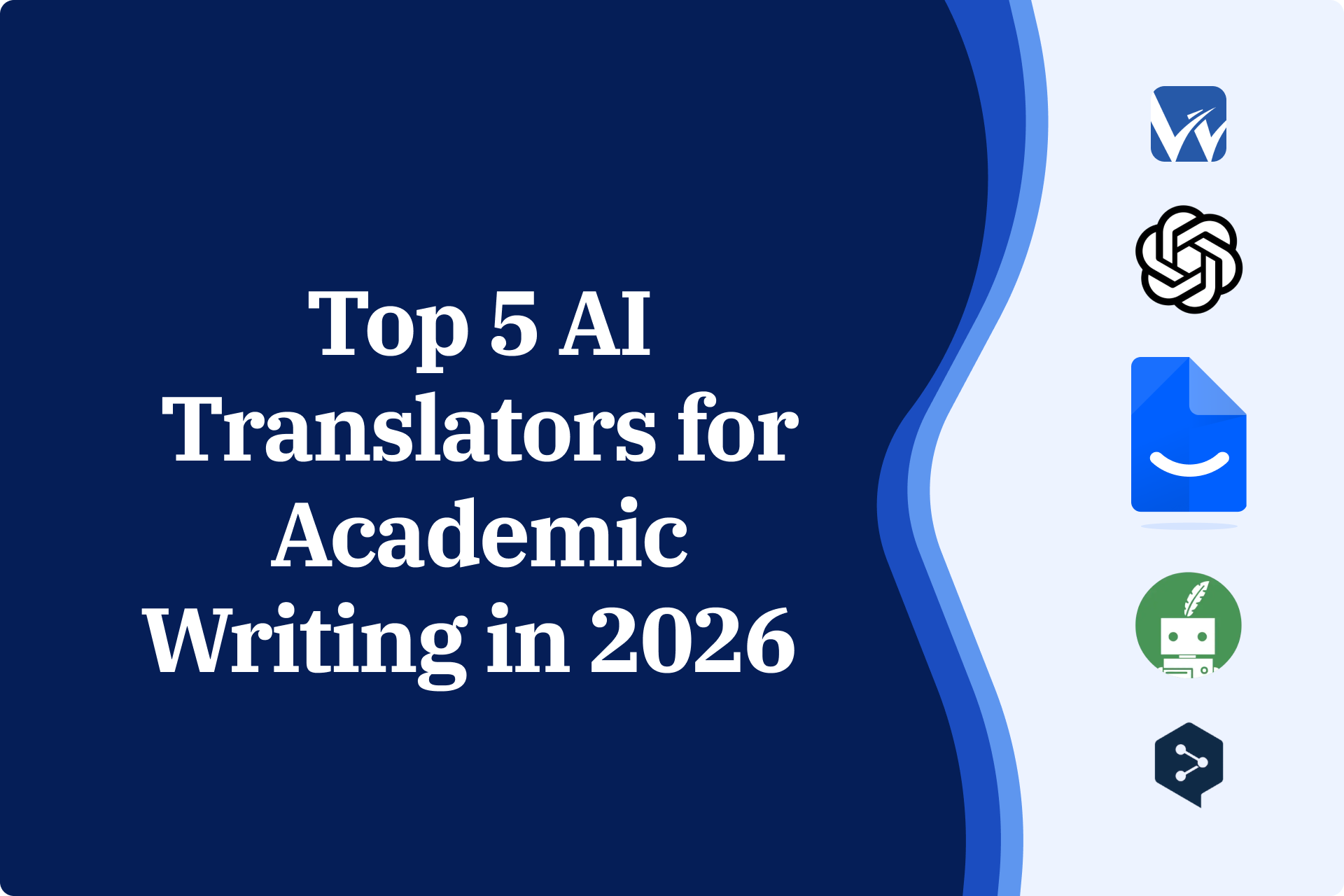
In this article, we review five top AI translation tools for academic writing, including DeepL, Paperpal, ChatGPT, QuillBot, and Wordvice AI, highlighting their top features, pros, and cons, to help you choose the right tool for your research needs.
Disclaimer
This article is based on independent research and is intended to provide an unbiased comparison of various AI writing tools, including our own. While we strive to present accurate and up-to-date information, features, and pricing, we recommend checking directly with the respective companies for the latest details, as offerings may change over time. Additionally, any opinions expressed here reflect the author’s perspective and may not represent the official stance of the companies/tools discussed.
Top 5 AI Translation Tools in 2026: Quick Snapshot
AI-powered translation tools have become essential in academia to quickly translate research papers while preserving the essence of the original work. Here is a quick overview of the 5 best academic translation tools used today.
| Tool | Languages Supported | Academic Accuracy | Additional Features | Pricing |
| Paperpal | Provides high-quality translation for over 50 language pairs | Most accurate for academic translations. Retains context, intended meaning, and technical terms | Academic editing, AI writing assistance, paraphrasing, research discovery, chat with PDF, citation support, plagiarism checks, AI detection, journal submission checks | Free access available. Paid plans offer full access to the all-in-one feature suite. Multi-year and team plans also available |
| DeepL | Translates over 100 languages | Professional-grade translations that are highly accurate | Glossary support and tone adjustment | Free tier and paid options with specific features in each |
| ChatGPT | Supports translation into over 50 languages | High accuracy in major global languages, not optimized for dense academic text | Writing, editing, rewriting, explanation of terms across languages | Free plan, with the option to choose a paid subscription |
| QuillBot | Capable of translating over 50 languages | Moderate to high translation accuracy | Paraphrasing, grammar checker, and summarizer tools | Offers free access, with a paid plan required for advanced features |
| Wordvice AI | Translates over 40 languages | High translation accuracy with academic focus | Proofreading, editing, and academic writing tools | Free with the option to upgrade to a paid plan to access all features |
The increasing use of AI language translators for research eliminates tedious human-led translation processes, saving time, reducing effort, and improving consistency. Below are five of the best AI translators for academic writing and research.
1. Paperpal
Among the best AI translators for academic writing, Paperpal delivers accurate translations across 50+ languages. It is specifically designed to understand academic context, structure, and intent, providing high-quality academic translations across major disciplines in minutes while preserving the original meaning, technical terms, and equations.
Ideal for those with English as a secondary language (ESL), Paperpal lets you write in your own language and translate seamlessly to English for submission. Beyond translation, Paperpal offers an extensive all-in-one feature suite to help you write and polish your work for submission, including grammar correction, paraphrasing support, AI reference finder, citation generator, chat with PDF, and key submission checks, including plagiarism and AI detection.
| Strengths | Weaknesses |
| Designed for academics, ensuring accurate, context-aware translation across 50+ languages while retaining meaning, intent, and technical terms. | Free plan offers limited usage, so you may need a paid plan for more in-depth support |
| Handles longer documents, efficiently translating multiple paragraphs at a time | |
| Accessible via the Web editor and in MS Word, allowing for distraction-free writing | |
| Provides end-to-end writing support, including editing, citation tools, and key submission checks | |
| Keeps your work confidential and secure; will never use your data to train its AI models |
2. DeepL
DeepL remains a popular AI language translator for research thanks to its strong contextual understanding, making it suitable for scientific and academic content that demands precision. This AI-powered translation tool allows users to upload entire documents (Word and PDF) for quick translation while preserving formatting. It also offers a glossary feature that enables researchers to ensure consistent terminology across translated texts and manuscripts.
| Strengths | Weaknesses |
| Highly accurate AI-powered translation in 100+ languages | Mainly a translation tool, limited academic writing features compared to all-in-one tools |
| Supports full document translation (Word and PDF formats) | |
| Glossary feature ensures terminology consistency in translations | |
| Offers tone and formality adjustment options |
3. ChatGPT
Unlike traditional AI-powered translation tools, ChatGPT leverages advanced large language models to interpret context, explain technical concepts, and deliver nuanced translations rather than literal word substitutions. This makes it a versatile AI translation tool that can also be used to draft and refine your academic documents.
| Strengths | Weaknesses |
| Ability to accurately explain technical terminology during translations | Prompt-based translations, accuracy depends heavily on the quality of prompt |
| Effective editing, rewriting, and summarization capabilities | Not specifically trained on academic literature, so results can vary for highly technical writing |
| Broadest language coverage among general-purpose AI powered translators |
4. QuillBot
Widely known for paraphrasing, QuillBot also serves as a capable AI language translator for academic writing. It helps researchers translate text across multiple languages while helping researchers refine tone, paraphrase translated sentences, and restructure complex paragraphs to improve clarity and readability.
| Strengths | Weaknesses |
| Advanced paraphrasing tools that complement translation | Translation accuracy can be lower for specialized technical terminology |
| Integrated writing support, including grammar checks and summarization tools to support your writing journey | Limited discipline-specific optimization for academic content |
5. Wordvice AI
Wordvice is a solid AI language translator for students and researchers needing both translation and writing support. It delivers academic translations across multiple languages and pairs this with grammar checks, style suggestions, proofreading, and editing to enhance overall writing clarity and flow, making it particularly popular among non-native English-speaking users.
| Strengths | Weaknesses |
| Combines AI-based academic translation with writing and editing support | Fewer translation-specific capabilities compared with more specialized AI translators |
| Helpful for researchers preparing manuscript for journal submission | Most of the advanced tools require a paid subscription |
| Provides reliable support for non-native English speakers |
How to Choose the Right AI Translation Tool for Academics
There are numerous AI translation tools available today, but not all are equipped to handle the complexity and attention to detail that academic writing demands. When choosing an AI translator for academic writing, focus on these key features:
- Accuracy with technical terms: Prioritize translation tools trained on academic and scientific literature that can handle discipline-specific vocabulary and technical terms accurately. Paperpal, with over 23 years of science, technical, and medical expertise and built to enhance academic literature, is highly effective when translating technical terms across research domains, especially STEM fields. On the other hand, DeepL’s flair for natural language makes it a great tool for translating manuscripts in the field of humanities, such as in Sociology and History.
- Context-aware translations: Academic documents require deep understanding of scientific and academic concepts. For example, the literal English translation of ‘Lebensraum,’ a German term used in ecology to refer to the natural environment in which a species lives, is ‘living space,’ but this would be inaccurate in scientific terms. The correct English scientific term would be ‘habitat.’ Leading AI language translators like Paperpal can analyze context and suggest the correct translations for academic text.
- Wide language-pair support: Choose academic text translation AI tools that offer broad language-pairing options (ideally 50+). This ensures that research can be easily accessed, written, and shared across different languages.
- Preservation of academic tone and style: Academic writing follows a formal structure and tone of voice that generic translation tools often fail to maintain. Choose an AI translation tool that go well beyond literal translation, preserving the formal structure, objectivity, and authentic voice required for high-quality submissions and journal publication.
- High confidentiality and data security: Select reliable AI translating tools that offer secure processing and encryption, and have clear policies regarding data storage. Since students and researchers often submit unpublished manuscripts, sensitive findings, and grant proposals to AI platforms for translations, it is important to ensure that work remains confidential and protected.
- Compatibility with writing platforms: An effective academic AI translator should integrate smoothly with popular word processors (e.g., MS Word), reference managers, and manuscript writing tools. This helps to reduce manual formatting and copying between systems, allowing for distraction-free writing.
- Added value beyond translation: While pricing is an important factor, consider overall productivity gains when choosing an academic AI translating tool. Additional features such as manuscript writing assistance, citation support, plagiarism checks, paraphrasing, and in-depth editing deliver greater time savings and end-to-end support.
Given the high quantum of scientific output being published globally, there is a growing emphasis on supporting multilingualism in science. Here. accurate academic AI translators play a vital role in fostering research collaborations and knowledge sharing.
Frequently Asked Questions
While AI translation tools make the tedious process of translation quicker and easier, accuracy varies when it comes to handling academic and scientific content. Purpose-built academic AI translation tools like Paperpal, which are trained on a millions of peer-reviewed literature, are able to quickly grasp the context, structure, and discipline-specific technical terms, ensuring precise translations that retain the original meaning or intent. While AI translators can eliminate manual effort and are fairly accurate, it’s recommended to do a thorough review of any AI-translated content before final submission.
Yes. Most leading AI translation tools support full document translation, including Word and PDF files. This eliminates the need to copy-paste translated text section by section, saving both time and effort.
AI translation tools are much faster and more cost-effective than human translation services. However, they sometimes lack the cultural fluency, understanding of linguistic nuances, and editorial judgment that only professional human translators can provide. Experts suggest combining the use of accurate AI translation tools with careful human review, especially when working with highly sensitive and nuanced technical/academic documents.
Most AI translation tools can handle common scientific vocabulary reasonably well. DeepL lets you lock in preferred translations for key terms via a custom glossary, while ChatGPT needs careful prompting for highly specialized terminology. QuillBot and Wordvice AI work well for general academic content but can be inconsistent when translating more advanced technical terms. Paperpal, trained on published literature, is particularly effective for translating research papers and technical manuscripts.
 Paperpal for China
 Paperpal for Korea
 Paperpal for Japan


 Speak to us