
If you are a researcher or student who has looked for help with plagiarism detection, citation formatting, or academic editing, chances are you have come across Scribbr. This Scribbr review takes an in-depth look at what the platform offers: how it works, what it costs, its key strengths, and where it falls short. Scribbr is a well-established resource, popular especially among students for proofreading, plagiarism checking, and citation generation. However, as researchers increasingly look for tools that support them throughout the research and writing journey, not just at the final check stage, many are exploring alternatives that offer more comprehensive, integrated support.
That’s where Paperpal comes in. Unlike standalone tools that address one or two specific needs, Paperpal is a purpose-built academic writing and submission-readiness toolkit designed to support researchers from the first draft to the final submission. This post covers a detailed Scribbr review, including its features, pros, cons, and pricing, and explains why Paperpal is the best Scribbr alternative for researchers who need end-to-end support.
Scribbr vs Paperpal: Quick Comparison
Take a look at this quick side-by-side comparison of Scribbr and Paperpal to help you get the big picture at a glance.
Table 1: Scribbr vs Paperpal: Quick Comparison
| Feature | Scribbr | Paperpal |
| Primary focus | Plagiarism check, AI detection, proofreading, citations | End-to-end academic writing, editing, and submission readiness |
| AI writing assistant | No | Yes |
| Grammar & language check | Basic grammar checker | Advanced, context-sensitive grammar and language suggestions |
| Plagiarism checker | Yes (pay-per-use; $19.95–$39.95) | Yes (included in Prime plan) |
| AI detector | Yes (via QuillBot; free) | Yes. Accurate AI content detection |
| Citation generator | Yes | Yes. 10,000+ citation styles, AI reference finder from 250M+ articles |
| Paraphrasing tool | Yes | Yes. Academic-tone paraphrasing with word reduction |
| Submission readiness checks | No | Yes. 30+ journal readiness checks |
| Platforms | Web | Web, MS Word, Google Docs, Overleaf, Chrome |
| Free tier | Limited (grammar checker, partial AI detection) | Yes. Meaningful free access with monthly limits |
| Pricing model | Pay-per-use (plagiarism/proofreading); no subscription | Free + Paperpal Prime from $25/month |
| Data security | Documents deleted after 12 months | User data never used to train AI models |
| Best for | Students needing plagiarism and citation checks | Researchers needing integrated writing-to-submission support |
Scribbr Review: Key Features
What is Scribbr?
Scribbr is an online academic support platform founded in the Netherlands. Originally built around plagiarism detection, it has since expanded to offer a range of writing assistance services. It is used primarily by students working on essays, theses, and dissertations. Since its acquisition by Course Hero (now Learneo), it has added an AI detection feature powered by QuillBot and a basic grammar checker. Scribbr is a credible, well-regarded platform, genuinely useful for what it sets out to do.
Who is it for?
Scribbr is designed for undergraduate and postgraduate students who need help polishing final drafts, checking for plagiarism, and generating citations in standard styles. It is less oriented toward active researchers who need support across drafting, literature search, and journal submission workflows.
Top Features
- Plagiarism checker: Compares your text against a large database of academic sources, websites, and student papers; provides a similarity score and source-level detail (see Figure 1)
- AI detector: Uses QuillBot’s AI detection technology to flag AI-generated content; identifies likely AI-written paragraphs
- Professional proofreading and editing: Human editors review your manuscript for grammar, clarity, structure, and style; pricing is per word
- Citation generator: Creates formatted references in APA, MLA, Chicago, and other major styles; supports citation list organization
- Grammar checker: Identifies basic grammatical errors and spelling issues
- Paraphrasing tool: Helps rephrase sentences to improve clarity or reduce overlap with sources
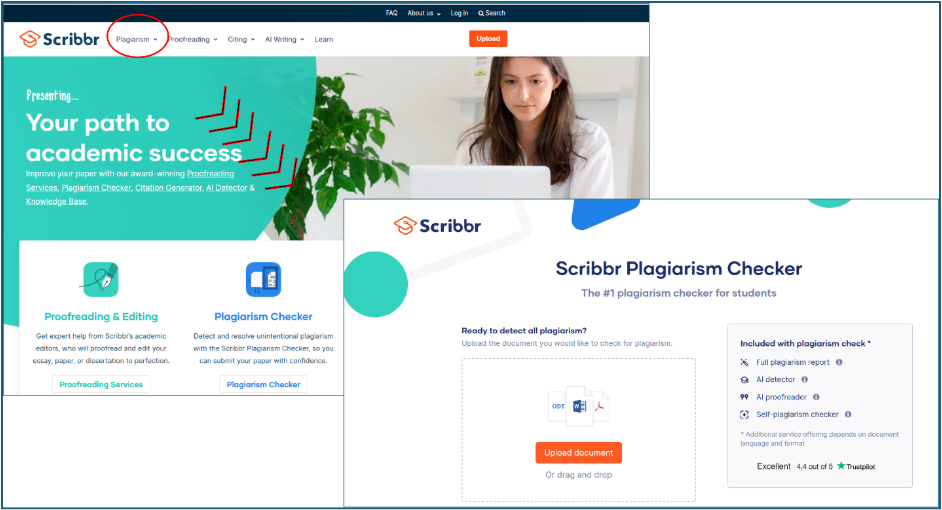
Figure 1: Screenshots of Scribbr homepage and plagiarism checker interface
Scribbr Pros and Cons
Here is a balanced look at where Scribbr delivers well and where it has limitations:
Table 2: Scribbr Pros and Cons
| Pros | Cons |
| Established, trusted platform with a strong reputation among students | AI detector is powered by QuillBot (third-party); accuracy limitations have been reported |
| Human proofreading from experienced academic editors | No subscription plan for plagiarism checking; each check is a separate, pay-per-use purchase |
| Plagiarism checker scans a comprehensive database including academic journals and student papers | Scribbr pricing can add up quickly; $19.95–$39.95 per plagiarism check with no free trial |
| Citation generator is well-regarded and supports multiple citation styles | Limited free access; the most useful features require payment |
| Clean, easy-to-navigate interface suitable for beginners | No active writing support; tools are primarily designed for checking a finished or near-finished draft |
| Documents are deleted after 12 months in line with privacy guidelines | No submission readiness checks, journal-specific language guidance, or research assistance |
| AI detector is free to use | Turnaround times for human editing can be slow, especially during peak periods |
| Multilingual support for AI detection (English, German, French, Spanish) | Not designed for the full research workflow; limited value beyond the final stages |
Why Paperpal Is The Best Scribbr Alternative for Researchers
Scribbr is undoubtedly useful for a plagiarism check or a round of professional proofreading before submission. But for researchers managing active writing and publication workflows, it leaves a significant gap. Most researchers today need more than a final-stage check. They need support throughout: while drafting, searching for references, revising, and preparing for journal submission. Switching between multiple standalone tools to cover these needs creates can be irksome. It also slows down the writing process and can increase the risk of errors.
Paperpal was built to solve exactly this problem. Backed by 24+ years of scientific, technical, and medical (STM) publishing expertise from Cactus Communications and trained on millions of scholarly articles, Paperpal understands how academic writing works. Besides simply catching errors, it understands discipline-specific language, academic tone, and journal conventions, offering suggestions that are genuinely appropriate for research manuscripts (see Figure 2).
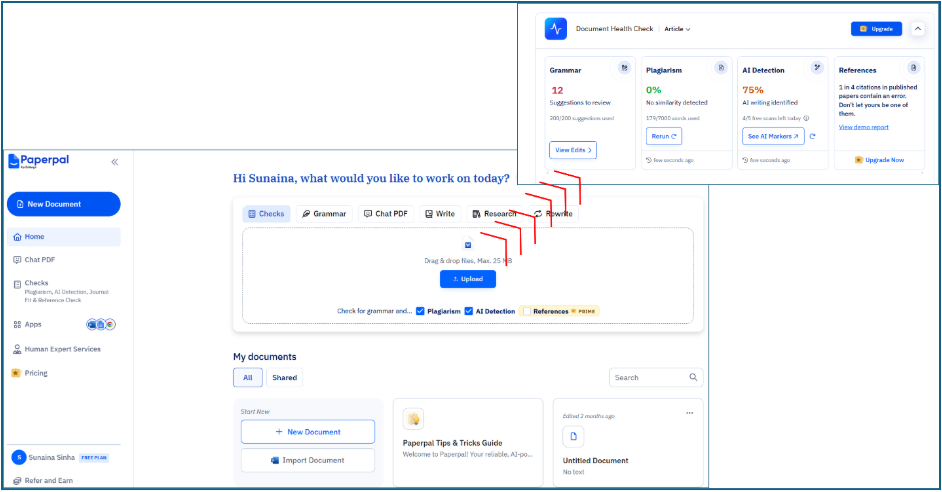
Figure 2. Screenshots of Paperpal editor showing language suggestions, submission checks, and plagiarism results in one interface
Key Features
- AI writing assistant: Helps generate outlines, abstracts, literature summaries, and full text from notes or prompts
- In-depth grammar and language check: Goes well beyond basic grammar; context-sensitive suggestions that preserve references, equations, and technical terminology
- Academic paraphrasing and word reduction: Lets you rewrite content without losing academic tone; reduces word count by 15%–35% to meet journal limits
- Plagiarism checker: Performs accurate similarity detection with color-coded, side-by-side source comparison
- AI detection: Identifies AI-generated content to support responsible, transparent academic writing
- AI reference finder: Searches 250M+ verified research articles to get science-backed answers to your research queries, cites sources accurately in 10,000+ styles
- 30+ journal readiness and submission checks: Reviews language, technical consistency, and formatting before you submit, flagging issues that lead to desk rejections
- Chat PDF: Interacts with PDFs to extract insights, compare multiple papers, and speed up literature review.
- AI translator: Translates across 50+ languages while preserving technical accuracy, abbreviations, and formulas
- AI Footprint and AI Disclosure Templates: Tracks exactly where and how AI has contributed to your draft; generates disclosure statements to meet publisher transparency requirements
Accurate, integrated, and trusted
What makes Paperpal stand out as a Scribbr alternative goes beyond the breadth of features—it is the quality and integration. With Paperpal, you do not need to copy-paste your text into five different tools to get from draft to submission. Everything happens in a single, seamless workflow on Web, MS Word, Google Docs, or Overleaf, wherever you already write.
For English-as-a-foreign language (EFL) researchers—who constitute a large share of the global research community—Paperpal’s suggestions are particularly valuable. They are calibrated to academic conventions, not just general English, so your writing sounds appropriately formal, precise, and discipline-appropriate without losing your voice.
Saves time, reduces workflow fragmentation
Research is hard enough without having to manage a patchwork of tools. Paperpal’s AI reference finder alone eliminates the need to switch between databases, browsers, and citation managers. The submission readiness checks catch issues that typically result in editorial returns or desk rejections, saving weeks of back-and-forth.
Security and responsible AI use
Data security and responsible AI are non-negotiable for researchers. Paperpal’s commitment on this is unambiguous: your data is never used to train AI models, and your files remain strictly yours. Paperpal also takes an active stance on ethical AI use, with features like AI Footprint (which shows exactly what AI contributed to your draft) and AI Disclosure Templates (which help you meet journals’ growing requirements for AI transparency). This makes Paperpal not just a powerful tool, but a responsible one: designed to enhance your authorship and protect your credibility.
Trusted by 4M+ academics and adopted by 200+ universities and 1,500+ journals, Paperpal is the all-in-one solution that researchers increasingly rely on to write better, faster, and with confidence.
To conclude
Scribbr is a reliable and well-established platform that serves a clear purpose: helping students check for plagiarism, generate citations, and polish drafts with human editorial support. For those specific tasks, it is truly useful. However, researchers today increasingly need reliable, integrated support throughout the research and writing journey, from the first sentence of a draft to the moment of journal submission. Scribbr, built primarily for students and final-stage checking, is not designed to meet that need.
Paperpal offers a stronger end-to-end solution. It combines accurate language editing, AI-assisted writing, literature search, plagiarism and AI detection, citation generation, and submission readiness checks in one trusted platform, backed by decades of scholarly publishing expertise. If you are a researcher looking for a Scribbr alternative that genuinely supports your work from start to submission, Paperpal is the clear choice. Try Paperpal for free and experience the difference.
Frequently Asked Questions
Q. How does Scribbr work?
A. Scribbr works as a web-based platform where you can upload your document to access a range of academic support tools. For plagiarism checking, Scribbr scans your text against a large database of academic sources, websites, and student papers, and returns a similarity score with source-level detail. For professional proofreading, you submit your document and a human editor reviews it for grammar, clarity, structure, and style. The citation generator lets you create formatted references manually or by searching by title or DOI. The AI detector, powered by QuillBot, analyses your text and flags content likely to have been generated by AI. Most tools work on a pay-per-use or limited-free basis.
Q. Is Scribbr legit and reliable?
A. Yes, Scribbr is a legitimate and well-established academic support service. Is Scribbr reliable for proofreading and citation generation? Generally, yes. It has a strong reputation in these areas, particularly among students. However, is Scribbr accurate for AI detection? This is where reviews are more mixed: the AI detection feature relies on QuillBot’s underlying model, and users have reported false positives. For plagiarism checking, Scribbr performs well on the whole, though as with all similarity-detection tools, it is advisable to use it alongside your own judgment and manual checks.
Q. Is Scribbr free to use?
A. Scribbr is not fully free. The grammar checker and AI detector have limited free access, but core features, including the plagiarism checker and professional editing services, require payment. Is Scribbr free for plagiarism checking? No: Scribbr pricing for plagiarism checks starts at $19.95 for documents up to 7,500 words, $29.95 for documents up to 50,000 words, and $39.95 for larger documents. There is no free trial for the plagiarism checker. Professional proofreading is priced per word, starting at $0.016 per word.
Q. Is Scribbr a good AI detector?
A. Results have been variable. The AI detector uses QuillBot’s detection technology (both platforms share a parent company), which relies on pattern recognition and natural language processing. While it can identify likely AI-generated text and flag specific paragraphs, users have reported instances of false positives, including human-written text being flagged as AI-generated. For academic integrity purposes, the tool is a useful starting point, but should not be treated as a definitive verdict. If AI detection accuracy is a priority, it is worth testing multiple tools and considering purpose-built options.
Q. Is Scribbr plagiarism checker good?
A. Is Scribbr plagiarism checker good? For its intended purpose, yes. It compares text against a wide database including academic journals, websites, and student papers, and provides a detailed similarity report with source-level comparisons. Users generally find it reliable for identifying unintentional overlaps and improving paraphrasing. The main drawback is the pricing model: each check is a separate purchase, which can become costly for researchers running multiple rounds of revision. So is Scribbr accurate for plagiarism detection overall? It performs reasonably well, though a few users note that it occasionally misses some issues that other tools catch.
Q. What is the best Scribbr alternative for researchers?
A. The best Scribbr alternative for researchers is Paperpal. While Scribbr is a good resource for plagiarism checking, citations, and student-focused proofreading, it does not support the full research and writing workflow. Paperpal is purpose-built for academics and goes far beyond what Scribbr offers: it combines advanced language editing, AI-assisted writing, literature search with 250M+ research articles, accurate plagiarism and AI detection, a citation generator in 10,000+ styles, and 30+ journal submission readiness checks, all in one integrated platform. Trusted by 4M+ academics and backed by 24+ years of STM publishing expertise, Paperpal is the comprehensive, secure, and responsible choice for researchers who want end-to-end support.
 Paperpal for China
 Paperpal for Korea
 Paperpal for Japan


 Speak to us