


Table of Contents
The research paper introduction is where you present your topic and demonstrate why your study matters and why existing literature cannot fully answer your research question. Beyond presenting your research problem and highlighting your study’s novelty, the introduction of a research paper often provides an overview of the paper’s structure to guide readers through what follows.
In this article, we understand how to write a research paper introduction that summarizes existing literature and identifies the knowledge gap your research fills, and how Paperpal can help you achieve it effortlessly.
What is a research paper introduction and why is it important?
A research paper introduction is the opening section that guides readers from a broad subject area to your specific research topic. It serves a roadmap that presents three key elements:
- What is already known about your topic (establishing context)
- What is lacking in current research (identifying the gap), and
- What you aim to accomplish (your objectives and contributions).
Positioned at the beginning of your paper, the introduction defines the scope of your research, provides background context, and explains why your work matters both academically and practically.
The introduction is critical because it determines whether readers will engage with your research. Here’s what a strong introduction accomplishes:
- Captures reader interest – A compelling introduction helps your audience gauge if the topic aligns with their interests and whether your paper is worth their time.
- Provides a roadmap – Readers gain a clear sense of your paper’s direction, methodology, and how your arguments will unfold, preventing confusion and helping them follow your logic throughout.
- Justifies your research – The introduction explains why your study matters by connecting it to real problems in your field or industry, making clear that your work fills a genuine knowledge gap rather than duplicating existing research.
Without a well-crafted introduction, readers may struggle to understand your research’s significance or feel lost when diving into your methodology and findings. The introduction is where you win or lose your audience, making it one of the most important sections of your entire paper.
How to write a research paper introduction with Paperpal Agents?
Paperpal Agents are AI-powered research assistants that help researchers work through complex academic tasks using natural-language instructions and relevant research context. They bring research, writing, and document-based tasks into one conversational workspace, so researchers can move from an idea or question to a more structured, useful output without switching between multiple tools.
Agents can help build reference-backed outlines, analyze uploaded documents and research libraries, discover recent and relevant literature, refine and rewrite academic text, and work with supporting evidence to address reviewer comments.
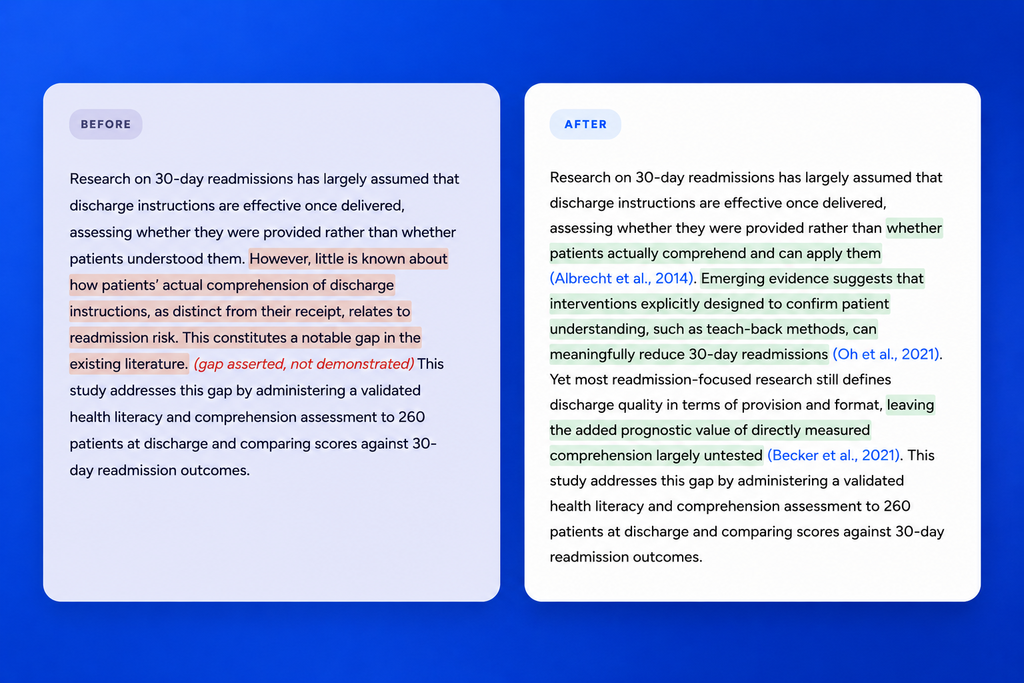
Stating a gap in the literature isn’t the same as justifying it. Reviewers want to know two things: what’s missing, and why it matters enough to need your study now. This is usually where a reviewer note like “your introduction lacks depth” comes from, and it’s the fastest thing to fix once you can see it clearly.
Paste your introduction into Paperpal Agent, with or without your full draft, along with any reviewer feedback or notes you have. Then run these two prompts in the same chat, one after the other.
Step 1: Find the Gaps in Your Reasoning
This prompt flags sentences that state a research gap without explaining why it matters:
Review my introduction. Identify sentences that state a research gap but don’t adequately justify why it matters or why it warrants this study. For each gap, note what prior research establishes, what remains unresolved, and how it connects to my study’s aim. Diagnose only, don’t rewrite. Use only what’s implied in the draft, and flag anything needing a citation with [SOURCE NEEDED].
Step 2: Turn the Diagnosis into a Stronger Argument
Once you have the diagnosis from Step 1, use this prompt in the same conversation to turn it into a rewritten paragraph backed by real citations:
Refine the [specific gap] into 3-4 tight sentences with the why-now reasoning, responding to the reviewer’s comment. Center the argument on [specific gap] and the critique that [specific gap]. Keep my original study aim sentence word for word. Find real sources via web search and fold them inline as one clean citation per claim, replacing [SOURCE NEEDED]. Match citation strength to wording, don’t overstate, and don’t stack or duplicate citations. If you can’t find a direct source, say so. Give me just the final paragraph.
See the results from this before & after picture →
The 3-Part formula for writing strong research introductions
Writing a compelling research paper introduction requires a strategic approach that moves from a broad context to your specific contribution. Here’s what to consider and how to structure each component:
Step 1: Establish your research topic
Start by showing readers why your research topic matters. Introduce the broader research field, explain its significance, and provide enough background for readers to understand the current state of knowledge. This is where you show you’ve done your homework, referencing key studies from the last 5-10 years to establish credibility. Use Paperpal Agents to find verified research papers related to your topic from a database of 300 million research papers.
What to include:
- The importance of your research field
- Background context readers need
- An overview of current research landscape
Example: “The inclusion of experiential and competency-based learning has benefitted electronics engineering education. Industry partnerships provide an excellent alternative for students wanting to engage in solving real-world challenges. Industry-academia participation has grown in recent years due to the need for skilled engineers with practical training and specialized expertise.”
Step 2: Identify your research niche
Once you’ve established the context, pinpoint exactly where your research fits. Reveal a gap in existing knowledge, challenge an assumption, or highlight a limitation that previous studies haven’t addressed. This is your justification for why your study needs to exist—you’re showing that current literature cannot fully answer your research question.
What to include:
- A specific gap or limitation in existing research
- Your research question or hypothesis (stated in past tense if already tested)
- Why this gap matters
Example: “However, very few studies have considered using educational research methods for performance evaluation of competency-based higher engineering education, with a focus on technical and transversal skills. To remedy the current need for evaluating competencies in STEM fields and providing sustainable development goals in engineering education, in this study, a comparison was drawn between study groups without and with industry partners.”
If your gap statement is getting flagged as under-justified, see How to Strengthen Your Research Paper Introduction with Paperpal Agent below for a prompt-based way to fix it.
Step 3: Fill the knowledge gap with your research
Now, clarify exactly how your study addresses the gap you’ve identified. State your study’s purpose, describe your approach, and highlight what makes your work novel. Give readers a preview of your key findings and explain how your paper is structured so they know what to expect.
What to include:
- Your study’s specific purpose and objectives
- Key characteristics of your methodology
- Overview of main results (brief)
- What’s novel about your contribution
- Paper structure roadmap (optional but helpful)
Example: “The study evaluates the main competency needed in the applied electronics course, which is a fundamental core subject for many electronics engineering undergraduate programs. We compared two groups —one with and one without an industrial partner —that offered real-world projects to solve during the semester. This comparison can help determine significant differences in both groups in terms of developing subject competency and achieving sustainable development goals.”
What to consider when writing a research paper introduction?
- Length and proportion: Keep your introduction proportional to your overall paper—typically 10-15% of total length. This ensures you provide enough context without overwhelming readers before they reach your core findings.
- Flow from general to specific: Think of it as a funnel that narrows from broad topic to your specific contribution. This logical progression helps readers follow your reasoning naturally.
- Strong opening is crucial: Your first sentence should hook readers and establish relevance immediately. Don’t waste this valuable real estate on overly generic statements.
- Skip what readers already know: Only include information directly related to your research problem. Avoid stuffing in general background that an average reader in your field would already understand. For example, if you’re comparing non-traditional methods for mechanical design optimization, don’t spend time explaining traditional methods or the basic differences between approaches—start with the state-of-the-art non-traditional methods and how algorithm efficiency is evaluated.
- Be selective with references: Cite only the essential works that establish your research territory and identify the gap you’re addressing. Save additional supporting references for your Discussion section where they can strengthen your findings. Your introduction isn’t a comprehensive literature review—it’s a strategic positioning of your work.
- Reference strategically: Focus on important recent work (last 5-10 years) that directly relates to your research question. Quality and relevance matter more than quantity.
- Avoid harsh criticism: While you need to identify gaps or limitations in existing research, avoid being overly critical of previous studies when establishing your rationale. Acknowledge what’s been done, highlight what’s missing, and move forward. Save comparative advantages of your method for the Discussion section.
- Don’t reveal your findings: The introduction is about presenting the question, not answering it. Resist the temptation to describe your study’s conclusions or results here—those belong exclusively in your Results and Discussion sections. Your job is to make readers want to know the answer, not to give it away prematurely.
- Be clear about your contribution: Despite avoiding premature conclusions, readers should still understand exactly what gap you’re filling, how you’re approaching it, and why it matters.Retry
Your research paper introduction section should convince the reader and motivate them to read further. If you’re feeling stuck or unsure about how to make an introduction in research, choose trusted AI academic writing assistants like Paperpal to effortlessly craft your research paper introduction and other sections of your research article.
Frequently Asked Questions
The purpose of the research paper introduction is to introduce the reader to the problem definition, justify the need for the study, and describe the main theme of the study. The aim is to gain the reader’s attention by providing them with necessary background information and establishing the main purpose and direction of the research.
A research paper introduction typically makes up about 10% of the total word count. For most papers, this translates to roughly 1–2 paragraphs or about 150–300 words, depending on the overall length. The introduction should be long enough to set up your topic, provide context, and state your thesis without overwhelming the reader with detail.
When deciding what to include in the research paper introduction, the rest of the paper should also be considered. The aim is to introduce the reader smoothly to the topic and facilitate an easy read without much dependency on external sources. Below is a list of elements you can include to prepare a research paper introduction outline and follow it when you are writing the research paper introduction.
Topic introduction: This can include key definitions and a brief history of the topic.
Research context and background: Offer the readers some general information and then narrow it down to specific aspects.
Details of the research you conducted: A brief literature review can be included to support your arguments or line of thought.
Rationale for the study: This establishes the relevance of your study and establishes its importance.
Importance of your research: The main contributions are highlighted to help establish the novelty of your study
Research hypothesis: Introduce your research question and propose an expected outcome.
Organization of the paper: Include a short paragraph of 3-4 sentences that highlights your plan for the entire paper
Cite only those works that are most relevant to your topic; as a general rule, you can include one to three. Note that readers want to see evidence of original thinking. So it is better to avoid using too many references as it does not leave much room for your personal standpoint to shine through.
Citations in your research paper introduction support the key points, and the number of citations depend on the subject matter and the point discussed. If the research paper introduction is too long or overflowing with citations, it is better to cite a few review articles rather than the individual articles summarized in the review.
A good point to remember when citing research papers in the introduction section is to include at least one-third of the references in the introduction.
The literature review plays a significant role in the research paper introduction section. A good literature review accomplishes the following:
Introduces the topic
Establishes the study’s significance
Provides an overview of the relevant literature
Provides context for the study using literature
Identifies knowledge gaps
However, remember to avoid making the following mistakes when writing a research paper introduction:
Do not use studies from the literature review to aggressively support your research
Avoid direct quoting
Do not allow literature review to be the focus of this section. Instead, the literature review should only aid in setting a foundation for the manuscript.
Tailoring your research introduction to a specific discipline means aligning with its conventions. In the sciences, focus on problem statements, hypotheses, and methods early on. In the humanities, provide broader context and theoretical grounding. You can also use Paperpal’s Change Tones feature to adjust the tonality of your introductions for different disciplines.
Always consider the audience’s expectations, some fields prefer a detailed example of introduction in research, while others value brevity and directness.
Common mistakes in a research paper introduction include making it too lengthy, being overly broad, or assuming too much reader knowledge. A strong research introduction should avoid fluff and focus on setting up the research question and rationale clearly. Keep it concise, avoid unnecessary background, and don’t include results or conclusions prematurely.
Once your paper is complete, revisit the research paper introduction to ensure it aligns with your final arguments and structure. Clarify your thesis if needed, ensure key terms are well-defined, and refine the flow so it logically leads into your body sections. This step helps create a more cohesive and accurate example of introduction in research.
 Paperpal for China
 Paperpal for Korea
 Paperpal for Japan


 Speak to us