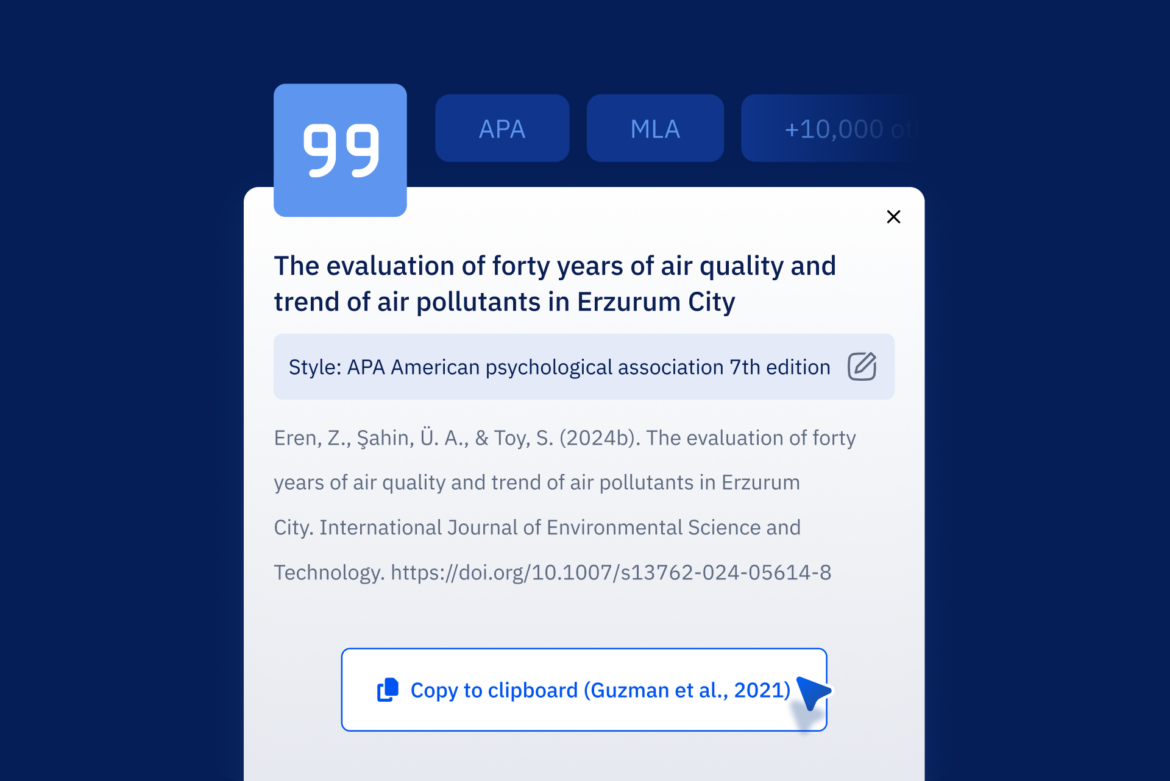

Summarize this Blog with AIReference managers like Mendeley have been popular for decades, but many academics are now exploring Mendeley alternatives to make the most of improved features and greater efficiency. Reference managers are needed to efficiently collect, organize, cite, and share academic sources. They ensure compliance with diverse style …
AI citation tools
Summarize this Blog with AIThe IEEE1 format for papers is a writing style guide used by the publications of the Institute of Electrical and Electronics Engineers (IEEE), the world’s largest technical professional organization that works toward advancing technology for the benefit of humanity. The IEEE publish approximately a third of …
Summarize this Blog with AIResearch and writing are core components in academia, and for good reason. Every piece of research is built on a foundation of evidence and fact, and this evidence must be presented in a way that makes it easy for readers to verify. That is why providing …
Summarize this Blog with AICitations are fundamental to maintaining the integrity and continuity of academic discussions. They allow researchers to guide readers to literary sources that they may have consulted during their study. Over the years, as the scope of academia and science grew and evolved, so did the need …
Summarize this Blog with AIWhat is APA 7th Edition? The American Psychological Association (APA) introduced the latest edition of the APA Style Manual (i.e., APA 7th edition) in 2019. APA Style has its origins in 1929, when a group of academics and professionals decided to develop a set of guidelines …
Summarize this Blog with AIAccurate citations are crucial for ensuring academic integrity, but it’s not easy to get it right. Students and researchers often struggle with managing their references, formatting citations, and ensuring consistency between in-text citations and reference lists. Missing or incorrect citations raise the risk of plagiarism, resulting …
Summarize this Blog with AIIt has been estimated that early career researchers and scientists spend 23%, or almost a quarter, of their working hours reading.¹ While this is a great way to learn from previous findings and insights and stay abreast of the latest developments, keeping track of the sheer …