

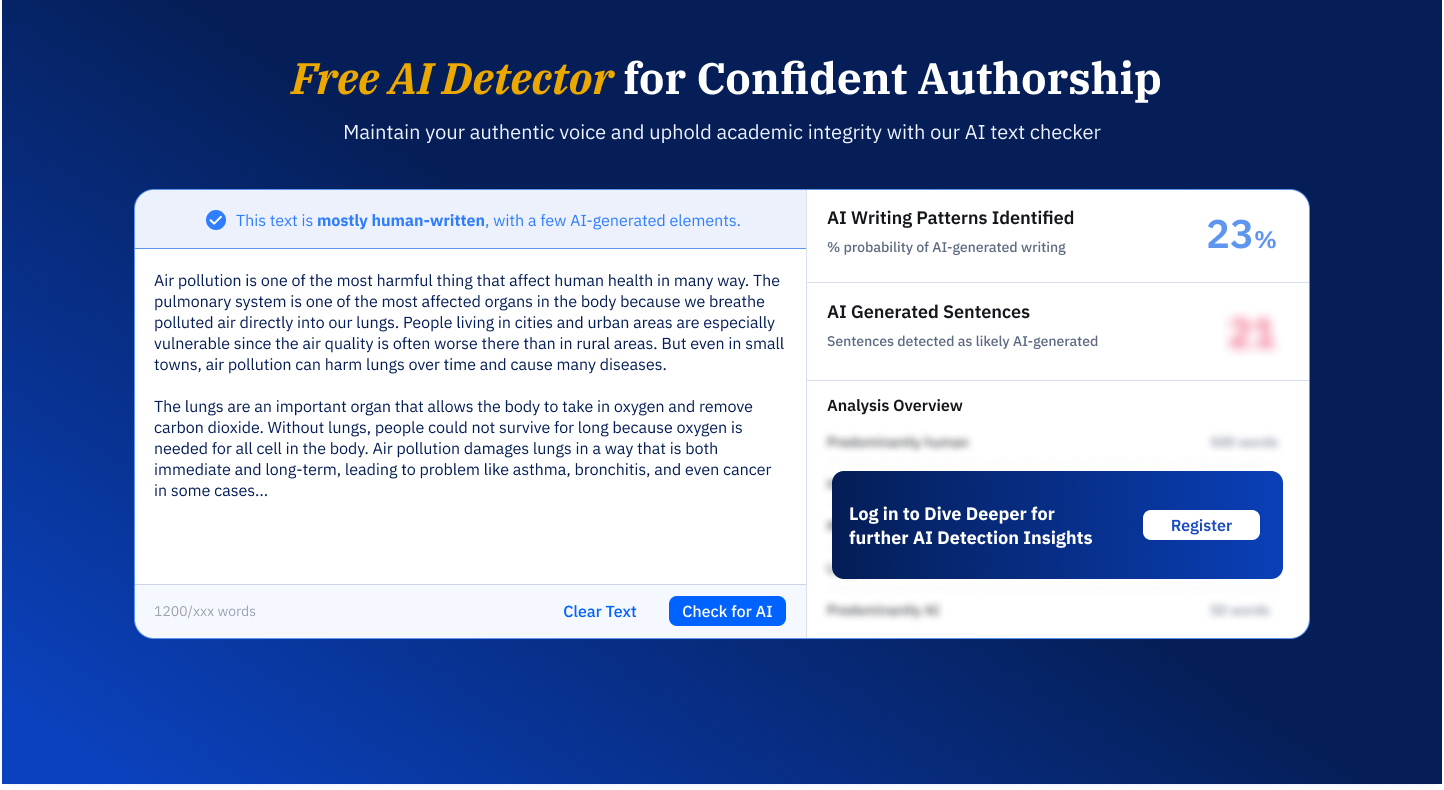
AI detectors and AI detection have become an unavoidable part of academic writing today. Universities and journals are experimenting with it, and students and researchers are increasingly encountering AI scores attached to their work.
But as AI detection tools become more widespread, so do their limitations: false positives are common, original work is flagged, and language editing or polishing can be mistaken for misconduct. Amid evolving AI use guidelines, authors are often left navigating uncertainty, anxiety, and inconsistent interpretations of what an AI detector score actually means.
The Paperpal AI Detector was built in response to this reality, not to add another layer of policing or judgment, but to bring transparency and clarity.
AI Detection in a World of Hybrid AI-Human Writing
Traditional AI detectors were designed to address a real concern: fully AI-generated submissions with little or no human thought. But academic writing today is rarely so clear-cut. Many students and researchers use AI responsibly to:
- brainstorm ideas
- structure arguments
- improve clarity and language
- polish academic tone
However, AI detection tools are built to evaluate writing style and statistical patterns, not intellectual ownership. As a result:
- original essays can receive high AI detection scores
- non-native English writers are disproportionately flagged
- language editing using AI raises questions on authorship
This creates a disconnect between why AI detection exists and how it is experienced by academics. Paperpal AI Detector was designed around these principles and presents them transparently.
Paperpal Introduces AI Detection for Clear, Confident Writing
As the world adopts technology, the line between “AI-written” and “human-written” is fast fading. Paperpal’s AI Detector, designed specifically for academics, reflects this reality: AI may be used to support language and structure, while the ideas and reasoning remain human-driven.
Rather than acting as a policing mechanism, Paperpal provides a contextual view of how AI may have influenced a piece of text, empowering authors to preserve their voice while using AI ethically. More explanatory than punitive, it takes an author-first approach instead of focusing on a score. Moreover, Paperpal does not claim to determine authorship, intent, effort, or integrity. Instead, it helps students, researchers, educators, reviewers and broader academics to understand patterns and signals within the writing itself.
How Paperpal AI Detection Works
Paperpal’s AI Detector evaluates text to assess the probability of text segments exhibiting characteristics of AI-generated language, identifying writing patterns and interpreting this in context. These insights then roll up into a document-level score, providing a more balanced and nuanced understanding of the text as a whole.
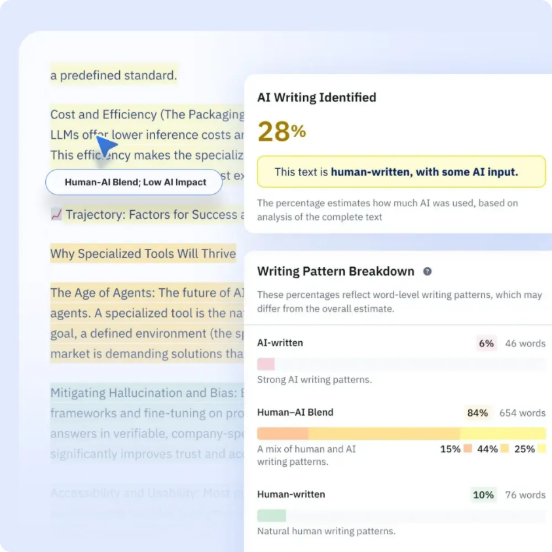
Paperpal’s AI Detector evaluates linguistic signals such as predictability and variation, then categorizes your writing using a transparent, three-band AI detection scale, categorizing your writing as:
- Human-written
- Human–AI blend
- AI-written
Rather than issuing a verdict, Paperpal’s AI Detector surfaces where these instances occur and why. It also retains document formatting and provides an interactive side-by-side view so authors can clearly see which passages need review. Paperpal then goes beyond AI detection to offer users seamless access to editing, plagiarism, and other features that allow for focused revisions all in one place.
Why Paperpal’s AI Detector Outshines Other AI Checkers
Built for academics, the Paperpal AI Detector is not designed to help authors “beat” AI checks or manipulate scores. It does not optimize text to bypass detection, make originality claims, or report to institutions. Most importantly, it keeps human judgment at the center. Paperpal provides context, patterns, and indicators, so people, not algorithms, make the final call; it trusts authors to ensure accuracy, originality, transparency, and academic integrity.
Here’s what makes Paperpal AI Detector better than other AI checkers:
- Trained on Real Academic Writing: Built on 100,000+ human and AI scholarly samples from ChatGPT, Claude, and Gemini, it provides more reliable AI detection than generic AI checkers.
- Multi-Model Engine for Higher Accuracy: Paperpal uses cross-verifying models to reduce false positives by over 40%, delivering research-grade AI detection that can stand up to institutional review.
- Transparent Three-Band Detection Scale: Paperpal’s three-band scale helps highlight hybrid writing to assess authenticity with precision, not guesswork.
- Zero Data Retention, Full Privacy: Paperpal’s AI Detector processes your text ephemerally using multi-level encryption. It will never store or use your data or work to train its AI, ensuring complete confidentiality and security.
- Continuously Updated for New AI Models: Paperpal’s AI Detector is retrained at specific intervals so it always stays ahead of any evolving generative AI systems and emerging writing patterns.
Together, these capabilities make Paperpal’s AI Detector not just another ChatGPT checker or AI text detector, but a reliable, academic-first system that academics need.
Frequently Asked Questions
Not by themselves. Most universities and journals treat AI detection results as an initial signal, not definitive evidence of misconduct. While language editing tools and grammar checkers are often permitted, the use of generative AI may be restricted or require disclosure. Policies vary by institution and publisher, so it’s important to review applicable guidelines and clearly declare any AI tool usage when submitting academic work.
Not consistently. Many AI detectors are trained primarily on outputs from specific models, such as GPT-3 or GPT-4, and may struggle to reliably detect text generated by newer or alternative AI writing tools, including Gemini, Claude, or open-source models. This limits their effectiveness across today’s diverse AI writing landscape.
Paperpal’s AI Detector is trained to identify AI-generated text from ChatGPT, Claude, and Gemini with 99% accuracy, offering a more nuanced AI detection report that empowers academics to quickly review and refine flagged sections to preserve originality and integrity.
Simply put, yes, it can. Paraphrased or AI-assisted text may sometimes be flagged by AI detectors if it appears overly uniform, generic, or statistically predictable; for example, ChatGPT checkers can catch overly consistent sentence length or formulaic phrasing.
Importantly, this does not automatically imply misconduct. Reviewing sections flagged by Paperpal’s AI Detector allows authors to refine language, restore their authentic voice, add appropriate citations, and disclose AI assistance where required. You can ensure your writing stays original and maintain academic integrity by using AI responsibly and transparently.
Yes! Paperpal’s free AI detector comes with 5 daily scans, supporting up to 1,200 words and 5 file uploads each. This allows academics to check their work for AI-generated content and assess writing integrity at zero cost.
For longer documents or more frequent use, a Paperpal Prime subscription provides unlimited AI detection scans and file uploads, supporting documents of up to 10,000 words per scan.
To conclude, AI detectors can be meaningful in academic writing, but they are not absolute indicators of human contribution. Used responsibly, AI detection tools can prompt review, discussion, and transparency. Used poorly, they can stir avoidable fear and misinterpretation. Paperpal AI Detector is built to sit firmly in the first category. By combining academic-specific AI detection with transparent scoring and access to integrated revision workflows, Paperpal aims to shift AI detection from simply being a compliance tool to one that offers clarity, supports scholarly integrity, and lets you write with confidence.
Paperpal is a comprehensive AI writing toolkit that helps students and researchers achieve 2x the writing in half the time. It leverages 23+ years of STM experience and insights from millions of research articles to provide in-depth academic writing, language editing, and submission readiness support to help you write better, faster.
Get accurate academic translations, rewriting support, grammar checks, vocabulary suggestions, and generative AI assistance that delivers human precision at machine speed. Try for free or upgrade to Paperpal Prime starting at US$25 a month to access premium features, including consistency, plagiarism, and 30+ submission readiness checks to help you succeed.
Experience the future of academic writing – Sign up to Paperpal and start writing for free!
 Paperpal for China
 Paperpal for Korea
 Paperpal for Japan


 Speak to us