


Table of Contents
You’ve finally ready to submit the manuscript you’ve spend months or years on. Yet, as the final submission deadline creeps closer, a familiar wave of anxiety sets in. “Was my phrasing academic enough for a top-tier journal?”; “Did I miss a citation and risk a plagiarism flag?”; “Will the editor run this through an AI detector and question my authentic work?”
For most researchers and students, answering these questions before manuscript submission usually means running an exhausting obstacle course of fragmented tools — a grammar checker here, a plagiarism scanner there, an AI detector somewhere else. A slow, disjointed workflow that steals hours and still leaves you uncertain.
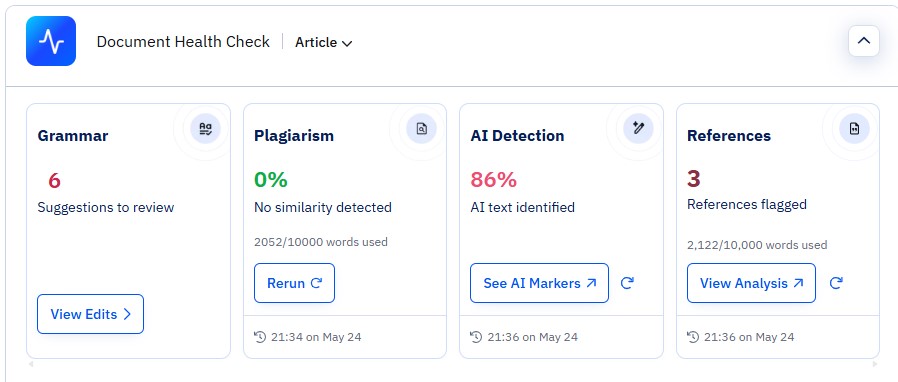
Your final checks before journal submission shouldn’t add friction. They should give you the clarity you need to submit confidently. That’s why Paperpal has introduced the Document Health Check, a single-click manuscript readiness check that scans your full draft across four critical dimensions, surfacing issues and suggesting fixes so you can submit the best version of your work.
Introducing Document Health Check: One Upload, Four Checks, Total Clarity
Accessible right from your Paperpal dashboard, this diagnostic framework allows you to upload your document and run four crucial pre-submission checks simultaneously — with just one click.
1. Plagiarism Check: Catch Similarity Issues Early
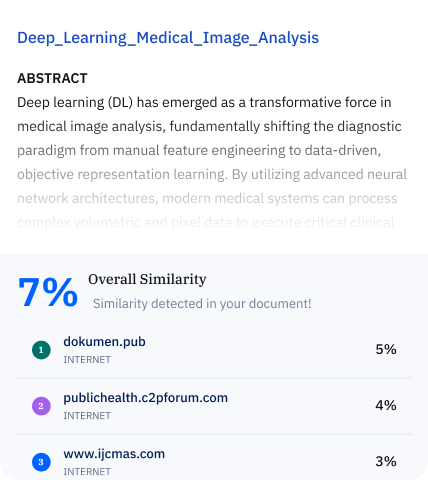
Accidental plagiarism is surprisingly easy to commit, especially when dealing with complex literature reviews, heavily referenced sections, or dense background data. A missing citation or overly similar paraphrasing can jeopardize your academic credibility before a reviewer even checks your science.
Paperpal’s plagiarism check for research paper submission cross-references your text against a massive, trusted repository of 99B+ webpages, including 200M open-access articles, to highlight overlapping content so you can quickly identify and address potential concerns. Even small instances of unintended overlap can cause delays or revision requests, making originality review an essential part of every manuscript submission checklist.
2. AI Detector: Spot Machine Writing Patterns
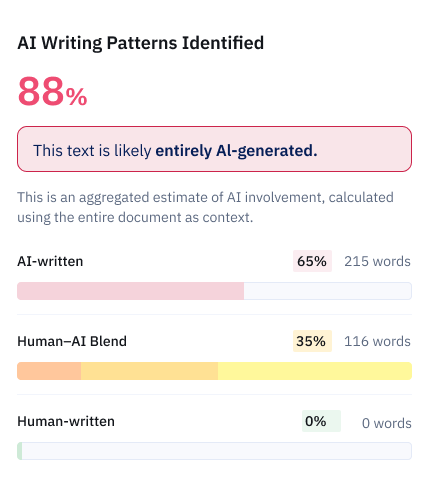
With institutional guidelines around generative AI changing constantly, transparency has become increasingly important. Paperpal’s AI detection for academic writing provides a clear, three-band categorization that helps you understand exactly where AI-generated content patterns exist in your writing, flagging sections that may need review before final submission. This gives you the chance to strengthen your phrasing, ensure consistency of voice, and ensure the manuscript accurately reflects your unique thinking and scholarly expertise.
Paperpal also provides publisher-aligned AI disclosure templates, so you have what you need to meet journal requirements without hunting through guidelines and looking for support elsewhere. This is particularly useful for teams working collaboratively or using AI tools during drafting and revision.
3. Grammar Correction: Sharpen Language and Clarity
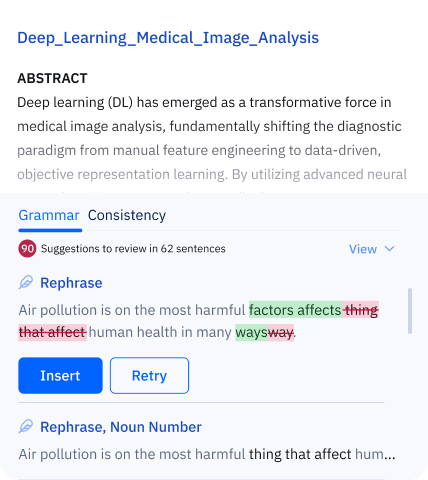
Standard spellcheckers are designed for everyday writing, not scholarly communication. They often miss discipline-specific language nuances and may suggest edits that introduce errors, undermining the precision and accuracy required in academic writing.
Paperpal’s grammar check for research paper, designed specifically for academic writing, goes deeper than basic spell checks. It identifies structural issues, improves clarity, preserves technical terminology, and helps authors meet the language expectations of international journals. Polished, publication-ready language allows reviewers to focus on the quality of the research rather than weeding out avoidable errors. For many researchers, especially those with English as a second language, this is one of the most valuable stages of manuscript review before submission process.
4. Reference Check: Ensure Every Citation Holds Up
Citation errors are one of the fastest ways to lose reviewer confidence. A strong argument can quickly lose credibility if it contains inaccurate or incorrectly formatted references, broken links, or retracted sources. For large manuscripts containing hundreds of references, manual verification can be both time-consuming and prone to errors.
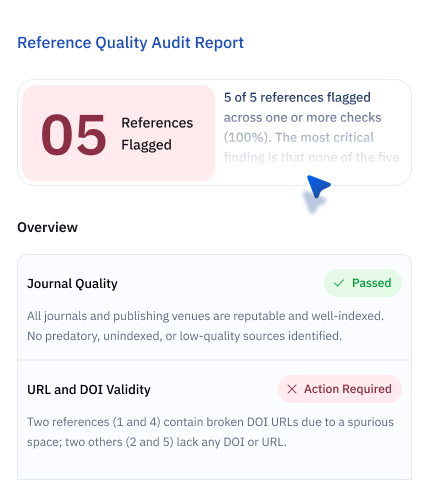
Enter Paperpal’s reference checker for research papers, which automatically reviews every source in your manuscript and performs nine validation checks covering accuracy, completeness, formatting, and source quality. You get a detailed report, with overall reference health and individual sources checked and a clear action list provided to help you see exactly what to fix before you submit.
Ready to submit? Get insights and suggestions to deliver submission-ready manuscripts in a click.
Paperpal Helps You Submit with Confidence
Most researchers don’t struggle with finding tools. They struggle with managing them. The old way of running research paper quality checks before submission meant acting as a project manager across half a dozen disconnected tools, with each tool provides only part of the picture. No more.
Paperpal returns your focus to the science, by centralizing these four vital checks into an automated pipeline. The Document Health Check replaces last-minute guesswork with clean, actionable diagnostics, providing transparent feedback and context-aware suggestions that lets you complete your academic writing checklist in minutes rather than days.
Whether you’re a Master’s student finalizing your graduation essay, a PhD candidate preparing a complex dissertation, or a career researcher targeting high-impact journal publication, Paperpal is built to get your manuscript across the line.
Most importantly, all documents processed through Document Health Check remain private and confidential and are never used to train Paperpal’s AI models.
Don’t leave your hard work to chance. Find out how to optimize your writing before you submit.
Frequently Asked Questions
Unlike generic tools built for casual writing, Paperpal is an academically trained AI assistant designed specifically for scholarly communication. This means its feedback is designed to align with academic writing conventions and journal publication requirements. The bigger differentiator is consolidation.
Instead of running a plagiarism check for your research paper in one tool, pasting your text into an AI detector for academic writing in another, and manually verifying references in a third, Paperpal’s Document Health Check runs all four checks — language and grammar, plagiarism, AI content detection, and reference verification — simultaneously on your full document. This holistic review is not just faster; it reduces the risk of issues slipping in when optimizing your draft to meet rigorous quality standards of leading universities and journals. For academics preparing a submission-ready manuscript, this kind of accurate, integrated review is something generic checkers simply can’t offer.
Absolutely. Paperpal’s Document Health Check works across academic writing at every level. Students can use it as an essay checker or thesis checker to run through their academic writing checklist before submitting their essays, coursework, reports, and assignments, checking for grammar issues, unintended similarity, and citation accuracy in one pass.
That said, it’s equally useful for post-graduate-level work. A Master’s student finalizing a thesis and a PhD candidate preparing a journal manuscript are running the same core risks — language that doesn’t meet publication standards, citation errors, or AI-generated content that needs review. The checks are the same; the stakes just get higher at each level. Paperpal’s unified Document Health Check is truly the final line of defense before every submission.
Paperpal’s Document Health Check is designed for the full range of academic document types: essays, assignments, research papers, theses, dissertations, conference papers, reports, and journal manuscripts. If it’s going to a supervisor, a committee, or a journal editor, it’s worth running through a manuscript readiness check first.
This versatile paper checker handles documents at any stage of completion, you don’t need a polished final draft to benefit from the diagnostic. Many researchers run a check mid-draft specifically to catch structural or citation issues before they compound.
The most impactful time is immediately before submission. Use it as a final pre-submission review for your research paper that confirms your manuscript is clean across all four dimensions before it reaches an editor or reviewer. Catching a reference error or an unintentional similarity flag at that stage is straightforward to fix; catching it after submission is not.
But it’s not just a submission check, the Document Health Check can be useful at multiple points in the writing process. Running it after a major revision helps verify that edits haven’t introduced new issues. Using it before sharing a draft with a supervisor or co-author means the feedback you receive is focused on substance, not surface-level corrections. Think of it less as a one-time gate and more as a standard part of your manuscript review before submission workflow.
Paperpal offers a free version of the Document Health Check that covers core checks: in-depth grammar review, plagiarism screening, and AI content detection. This gives researchers access to a meaningful research paper quality check before submission without a paywall.
Some capabilities like a deeper similarity analysis, full AI content report, and the advanced reference check are available under Paperpal’s subscription plans. If you’re preparing a high-stakes submission like a PhD dissertation or a manuscript for a competitive journal, the additional depth is worth it. But the free tier gives you a solid, actionable baseline.
Yes, and this matters more for academic work than most people account for. Unpublished research, original arguments, and novel data represent real intellectual property, and sharing them with a generic tool that indexes or stores content is a genuine risk some researchers don’t consider until it’s too late.
When you upload a manuscript or dissertation to Paperpal, your research document remains confidential and is not added to any public repository or similarity database. Your work stays yours, always. Paperpal never uses it to train its AI models. This security-first design is a deliberate decision, not an afterthought, because academic trust depends on it.
Paperpal is a comprehensive AI writing toolkit that helps students and researchers achieve 2x the writing in half the time. It leverages 24+ years of STM experience and insights from millions of research articles to provide in-depth academic writing, language editing, and submission readiness checks to help you write better, faster and submit with confidence.
Get accurate academic translations, rewriting support, grammar checks, vocabulary suggestions, and generative AI assistance that delivers human precision at machine speed. Try for free or upgrade to Paperpal Prime starting at US$25 a month to access premium features, including consistency, plagiarism, AI detection, reference checks, and 30+ journal submission compliance checks to help you succeed.
Experience the future of academic writing – Sign up to Paperpal and start writing for free!
 Paperpal for China
 Paperpal for Korea
 Paperpal for Japan


 Speak to us